Summary
Hypercubism is both a philosophical perspective and a structured theory. While this page explores its deeper meaning and interpretation, the full theoretical framework. including its dimensions, method and structure, is presented in the Theory of Hypercubism. Explore the ful theory here!
The philosophy of Hypercubism (Hyperkubismi) is not a thought or idea that arose in one day, one week, or even one year. The first thoughts have appeared in previous writings as early as 2022. The philosophy of Hypercubism is the consistent outcome of philosophical works and articles written between 2017 and 2024, a painterly method and style that crystallizes an introspective and structural view of oneself and the surrounding reality.
Although previously written philosophical writings largely deal with self-examination and the observation of one’s own self and reality, the ultimate goal of all texts has been to understand one’s own self and reality with its structures. The purpose of self-examination has been to gain access to the purest expression of one’s own self as an individual, as well as the interaction of one’s own self with the events and things taking place in the surrounding reality. Solving and observing the problems manifested in events and things has also created a view of one’s own self and reality as an equational whole. Examining, dismantling and rebuilding this equation is therefore a personal thought process that serves as the principle for constructing oneself and one’s worldview. This resonates strongly with the fundamental question of traditional cubism.
One of the goals of traditional Cubism was to break down an object that appears in reality into as many perspective parts as possible, and to reconstruct it into a perspective that corresponds to the idea from as many angles as possible at the same time. Cubists broke down the image, analyzed it, and reassembled it in the form of a painting on a two-dimensional surface (2D). Cubists were influenced by theories that were influential at the time, such as the theory of relativity, in which the fourth dimension was thought to be time.
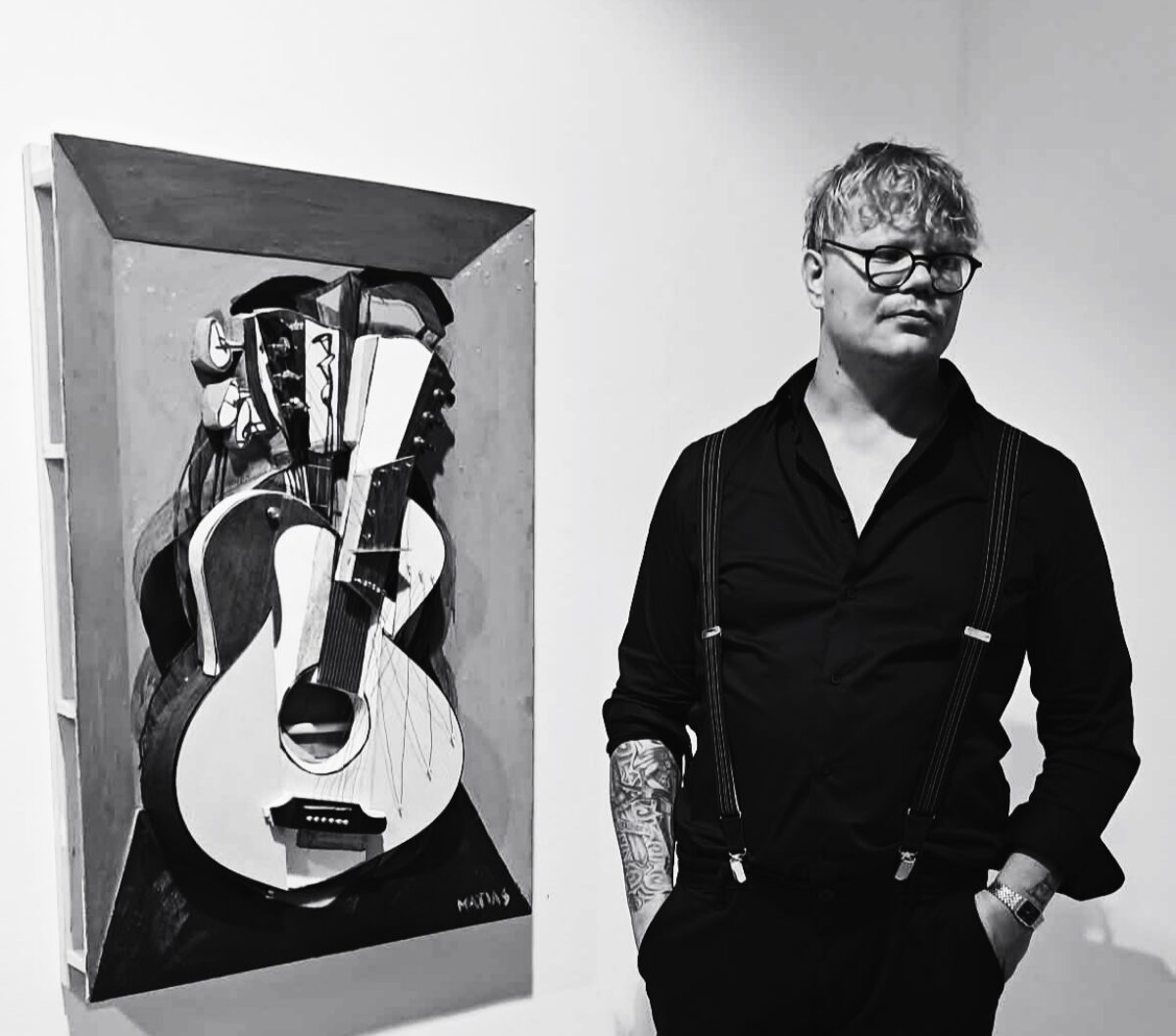
Hypercubism continues the Cubism theme of multi-perspective, taking it a step further. Whereas traditional Cubists presented a three-dimensional object as a disassembled, analyzed, and reconstructed painting on a two-dimensional surface, Hypercubism constructs the image as a three-dimensional (3D) layered multi-perspective whole. Whereas traditional Cubists thought the fourth-dimensional (4D) coordinate was time, in Hypercubism the fourth-dimensional (Mind and Thought) coordinate is in and out .
Hypercubist works also involve conscious material choices. Old materials, such as wood, fabric, wallpaper, and old clothes, are used in the works as elements that depict reality and respect the history of materials. They bring to the work manifestations of concrete reality, materials that physically describe the structures and properties that manifest in our reality.
Whereas traditional cubists deconstructed the image and placed it in a multi-perspective pictorial work in accordance with their ideas, in hypercubism the interpreter also deconstructs himself, his way of thinking and his reality into one concrete multi-layered work. The work embodies the third dimension (information and interaction), the fourth dimension (mind and thought) and also the fifth dimension (consciousness). Elements of the third dimension, such as collage and material choices, concretize the presence of the third dimension. Processes of the mind and thought, such as different perspectives and the still life of the elements of the work, embody the fourth dimension. The basis of the work is the consciousness of the fifth dimension, which includes understanding, insights and builds the entire work on the basis of the self-research and analytical process of the work.
Although introspection and understanding of reality play a large part in hypercubist thinking, its ultimate goal is to first strive to understand oneself and the structures of reality before it is possible to construct a pure, multidimensional work that follows hypercubist principles.
Philosophies and writings behind Hypercubism
As mentioned, Hypercubism is the culmination of thoughts and ideas written and produced over many years.
2018 Philosophical Writings (Filosofiset kertomukset)
In 2018, the first philosophical stories were created: The White Room and In the Middle of the Cubes .
The White Room essay deals with an self to self conversation, where a character finds himself in a white cubic room. Here he meets another character, who is himself. The character converses with another character, his own self, in a cubic white room that he has built himself. The essay reflects later essays on the cubic self as a state of consciousness and the dimension of consciousness.
In the middle of the cubes, the character is in the middle of cubes of different sizes, observing these cubes and examining their properties. At the end of the story, a massive cube falls in front of the character, which he examines and considers massive. This story foreshadows the perception of the entirety of reality, different dimensions and factors in reality.
2019 Life is in the shape of a circle (Elämä on ympyrän muotoinen)- books
Life is in the shape of a circle – Six-stage Self-examination and Life is in the shape of a circle – Workbook, published in 2019, embody the philosophy of life that emerged from the results of self-inquiry and reflections written in 2017-2019, and also serves as a method of self-inquiry.
The six-stage self-examination involve examining an event or thing, analyzing, self-examination, insight and realization, and changing an action or thought.
The workbook presents the philosophy of Life is in the shape of a circle, which, in addition to six stages of self-examination, includes:
- Six-stage self-examination Problem, nature of the problem, analysis, introspection, and change.
- The Three Stages of Being: Understanding, Acceptance, and Letting Go
- the Self: the Self
This method of introspection is also seen in hypercubism as a method of deconstructing one’s own self, but also reality.
2019-2020 Life is in the shape of a circle (Elämä on ympyrän muotoinen)- articles, Selected poems (Valitut runot)
Between 2019 and 2020, the theme Life is in the shape of a circle continued in the form of articles. The articles began to deal with information and its manifestation in the life of an individual, as well as the interaction of an individual with information. The texts anticipated the later written theory of dimensions, where the interaction of information between dimensions plays a central role. The texts also addressed the theme of intelligence and originality , as well as need in the life of an individual.
Around the same time, perhaps amidst analytical writings about oneself and reality, poetry was also born that dealt with the same themes. The cubist poem, in all its brevity, crystallized the passion and thinking of cubist research. The situation poem, on the other hand, actually crystallized, in its own way, the entire hypercubist artistic process in poetic form.
2022 Dimensions to talk about (Ulottuvuudet puhuttavat)
In 2022, I had already begun to explore Cubism through painterly works, which inspired me to write about my thoughts on traditional Cubism, the fourth dimension, and my personal views on these.
In these texts I shared my thoughts on how I felt traditional Cubism was incomplete and shared my personal view of the fourth dimension for the first time. In these texts I also discussed perspective and the history of Cubism, which I sought to explore in writing to structure my thinking behind my painting processes.
The texts Dimensions to Speak and Dimensions to Speak II anticipate the theory of dimensions, but also hypercubist philosophy through the definitions of the fourth dimension and the studies and ideas of cubism that appear in them.
2023 Studies of Mikulandská (Mikulandskán tutkimukset)
In 2023, I studied fine arts at the University of Fine Arts in Prague, Czech Republic, as an exchange student through my school. During this time, I ran into an artistic dilemma, through which I discovered the current way of painting and producing distinctively painterly works. This style emerged as the end result of my studies of Cubism and a breaking point where the old way of painting Cubism no longer corresponded to my way of thinking.
2024 Inside the Cube – thesis (Kuution sisällä)
In 2024, I graduated from the Kankaanpää Art School, which operated under the auspices of Satakunta University of Applied Sciences. My final thesis from the school is one of my significant writings on the background of hypercubism.
Inside the Cube – thesis includes Theory of Dimensions and first reflections under the concept of hypercubism. Overall, the thesis also anticipates the emergence of metatronics, in which Life is circular – philosophy and Theory of Dimensions – form one unified whole. The writing also included my personal reflections on cubism, creativity, imagination as well as a process description over the years regarding my painterly output.
You can explore hypercubist painted studies from here!
HYPERCUBISM, PART I
The Manifesto and Philosophy of Hypercubism was first published on November 21, 2025 under the title Hypercubism, Part 1. Hypercubism Part 1 includes:
I. MANIFESTO (MANIFESTI) , which presents the introduction, declaration, method, principles, and vision.
II. PHILOSOPHY (FILOSOFIA) that presents a crystallized hypercubist philosophy with its methods and definitions.
III. ARTIST TEXT (TAITEILIJATEKSTI) that reveals the most important temporal events behind Hypercubism.
You can read more about Hypercubism (Hyperkubismi) in the Hypercubism (Hyperkubismi) section.
Hypercubism, part I -also available at Academia.edu from here!
HYPERCUBISM, PART II
Published February 11, 2026
ABSTRACT
Hypercubism, Part II, analyzes the structures of reality and experience through three dimensions: 3D (information and interaction), 4D (mind and thought), and 5D (consciousness). The work deals with each dimension separately, presenting the characteristics of each dimension in relation to existing research. The third dimension deals with physics, geometry, biology, and the laws of nature. The fourth dimension draws on psychological perspectives. The nature of fifth dimension remains intentionally open. Although the geometric model clarifies the interaction between the dimensions, the stronger role of consciousness remains under investigation.
Three-dimensional reality is therefore, in the light of existing research, a structural and measurable fact. The fourth dimension encompasses the mind and thought, interpretation, and thought structures and processes. The fifth dimension, consciousness, encompasses the individual self and consciousness. Our reality is experienced through consciousness.
The purpose of this text is not to make any claims, but to present a coherent and alternative way of looking at reality and the experience that defines it. This text is a continuation of Hypercubism, Part I, which contains a manifesto, a philosophy, and an artist’s text. It would be a good idea to review and read that text first before moving on to Hypercubism, Part II. This text also serves as an intermediate step to the final text, Hypercubism, Part III, in which the structure that has now been dismantled is reassembled through the means of art.
Keywords:
Hypercubism, consciousness, experience, mind, self-examination, reality, dimension, information, 3D, 4D, 5D
I. INTRODUCTION (JOHDANTO)
II. INTRODUCTION II (JOHDANTO II)
III. AXIOMS AND PRINCIPLES (AKSIOOMAT JA PERIAATTEET)
IV. REALITY (TODELLISUUS)
The external world (ULKOINEN MAAILMA)
The inner world (SISÄINEN MAAILMA)
Depth dimension (SYVYYSULOTTUVUUS)
V. DIMENSION DIAGRAMS (ULOTTUVUUS -KAAVIOT)
VI. SELF-EXAMINATION DIAGRAMS (ITSETUTKISKELU -KAAVIOT)
VII. METATRONICS DIAGRAMS (METATRONIIKKA -KAAVIOT)
VIII. THOUGHT STRUCTURE DIAGRAM (AJATUSRAKENNE -KAAVIO)
IX. HYPERCUBISM AND ANCIENT PHILOSOPHY (HYPERKUBISMI JA ANTIIKIN FILOSOFIA)
Hypercubism, part II -also available at Academia.edu from here!
You can FIND references and full pdf- article for download from Hypercubism, part II -section! (Suomeksi, HYPERKUBISMI, OSA II)
HYPERCUBISM, PART III
The article Hypercubism, Part III constitutes the third part of the philosophical framework of Hypercubism, which examines the manifestation of theory in artistic work and the development of expression. The text is based on a long-term personal research process that combines visual artistic work, philosophical thinking, and reflection on perception and reality.
The article describes how the key principles of Hypercubism, such as multidimensionality, the relationship between reality and experience, and the role of the mind in the construction of perception, are manifested in the practical artistic process. The material is paintings and studies completed in 2020-2026, through which the transformation of expression towards a freer and more multidimensional approach is analyzed.
The text traces the evolution of artistic practice from a representative and structurally controlled expression towards a more intuitive and conceptually broader form. The process also includes critical stages that have guided the reassessment of thinking and deepened the relationship with the philosophical foundations of Hypercubism.
The article shows that Hypercubism functions in practice as an influential model of thought and perception, shaping both the artistic process and the way we structure reality. It functions as an applied and researched part of the broader Hypercubism whole.
PREFACE
Love can change, people can disappear, life can be different today than it was yesterday, and become completely different tomorrow.
Yet reality itself remains unchanged That is why I seek its deepest truth. I can trust that it is the only one that will last.
This text is dedicated to all those who have helped me achieve the things I have achieved over these ten years. The theory of Hypercubism would not exist without your understanding, acceptance and love.
I would especially like to dedicate this text to Octavian Iordache, who has shown me that this has not been in vain.
I. INTRODUCTION (JOHDANTO)
II. INTRODUCTION II (JOHDANTO II)
III. RESEARCH ON CUBISM (KUBISMIN TUTKIMUS)
Cubism studies through paintings (Maalauksellinen tutkimus)
Theoretical research (AJATUKSELLINEN TUTKIMUS)
History of Cubism (KUBISMIN HISTORIA)
Cubism and Hypercubism (KUBISMI JA HYPERKUBISMI)
IV. RESEARCH ON HYPERCUBISM (HYPERKUBISMIN TUTKIMUS)
Diagrams of a hypercubist work (HYPERKUBISTISEN TEOKSEN KAAVIOT)
Process description; Guitar II (Prosessikuvaus; Kitara II)
Hypercubist studies (hyperkubistiset tutkielmat)
Theoretical research (Ajatuksellinen tutkimus)
V. DIMENSIONISM (DIMENSIONISMI)
VI. POLYTOPISM (POLYTOPISMI)
FINAL WORDS
Hypercubism has been given its framework, and its rough lines have settled in place. The project of several years can now rest and breathe a little, and the research continues with painting. Writing the theory has been interesting, to say the least.
Although Hypercubism may seem very absolute at first glance, it nevertheless invites artists to examine and develop this new way of thinking. Hypercubism offers a method and regularity, but does not eliminate creative perspectives or applications for its implementation. However, everyone has a personal way of thinking and seeing and experiencing reality as they feel is best for themselves. This would also be desirable, at the very least.
Hypercubism, Part III, offers an artistic application of the written philosophy. However, it is good to return to the first part after this part and examine it as a process. Just as life is circular, so too Hypercubism manifests itself as a circular process. The first writings will certainly appear in a different light after this article.
Once the final Hypercubist studies are complete, the artistic work on Hypercubism will begin in earnest. The next step is also to explore Octavian Iordache’s idea, Hypercubism of Hypercubism, or 8D art.
I wish everyone rewarding reading moments, great insights, and curiosity.
Signature
Anssi Matias Miettinen
21.4.2026
Tampere, Finland
REFERENCES
Aurasmaa, A., Bergström, K., Donner,K., Jokinen,T., Lahti,J., Räsänen, E., Törmä,M., Viljasaari,M. & Väätäinen,M. (2015). Perspektiivi kuvataiteen historiassa. Toim. Vakkari,J. Gaudeamus.
Al-Khalili, J. (1999). Mustia aukkoja, madonreikiä ja aikakoneita. Suomentaja Karttunen, H. Gummerus Kirjapaino Oy.
Honour,H., Fleming,J. (1999). A World History of Art (uudistettu laitos). Suom. Itkonen-Kaila, M., Kokkonen,J., Mattila, R., Palin, T. & Sauri.S. Otava.
Kaku, M. (1994). Hyperspace. Oxford University Press, Inc.
Miettinen, A. (3.5.2018). Kuutioiden keskellä. Valkoinen huone.
Matias, A. (2020). Vain eläin, joka osaa puhua. Kirjapaino Bookcover Oy.
McGivern, H. (2018, November 7). When the avantgarde met E=mc2: The story behind dimensionism. The Art Newspaper.
Miettinen, A. (2024). Kuution sisällä (Opinnäytetyö, SAMK). Theseus. https://www.theseus.fi
Miettinen, A. (2023). Mikulandskán tutkimuksia. https://www.anssimatias.com
Miettinen, A. (2022a). Ulottuvuudet puhuttavat. https://www.anssimatias.com
Miettinen, A. (2022b). Ulottuvuudet puhuttavat II. https://www.anssimatias.com
Iordache, O. (2006). Polytopism Manifesto. https://www.polytopism.com
Sirató, C. (1936). The Dimensionist manifesto. Paris.