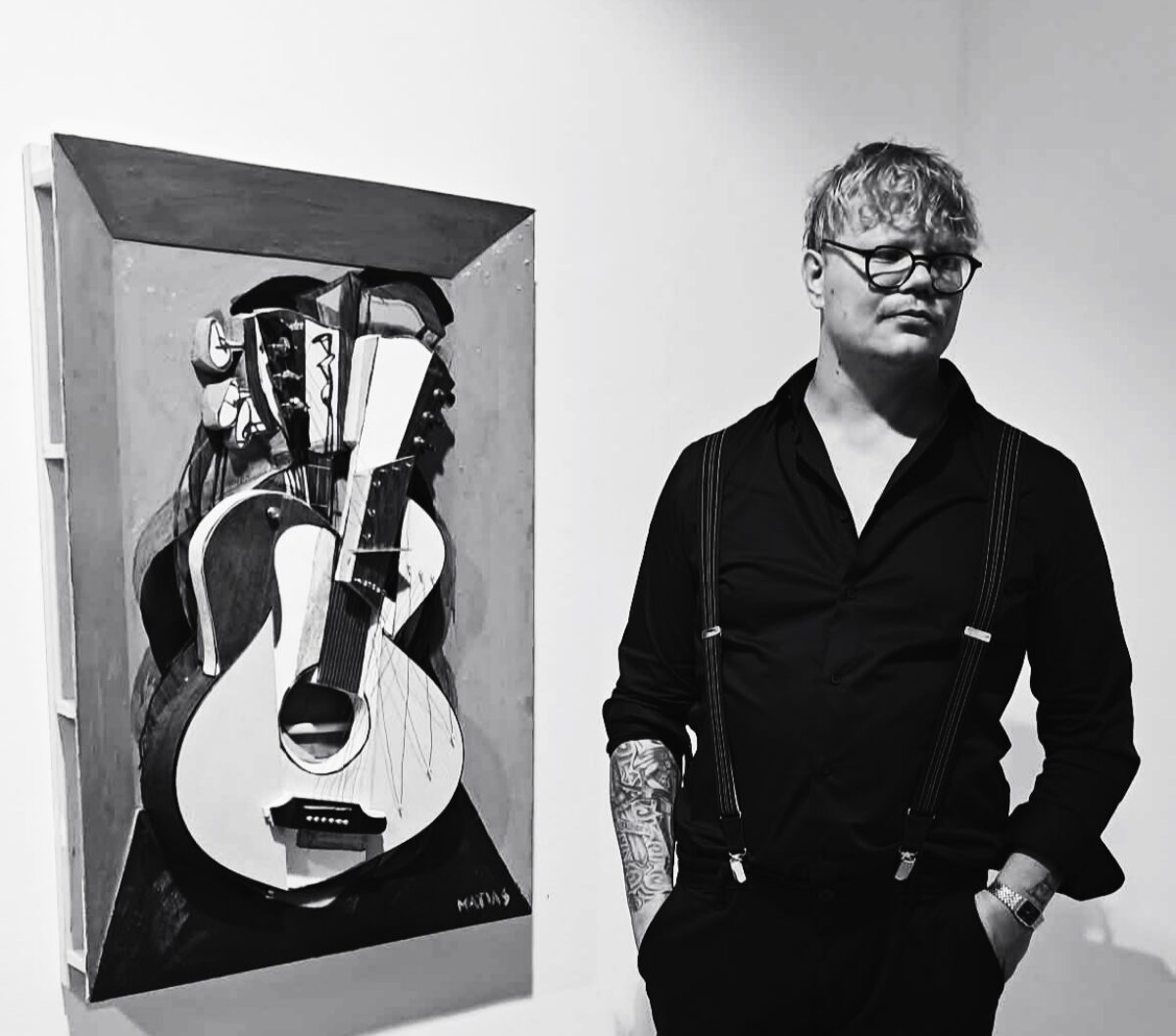
The study of Hypercubism is both a literary and visual study. Whereas Hypercubism, Part I presented the manifesto and philosophy, and Hypercubism, Part II deepened the philosophical claims of Hypercubism, presenting diagrams and axioms and principles, Hypercubism, Part III presents the artistic application.
The text discusses the history of traditional Cubism and the author’s personal reflections on the subject. Cubism’s importance to the emergence of Hypercubism has been significant, and therefore it is important to examine written reflections on Cubism, but also research done through painting in the form of works. Hypercubism is not an extension of Cubism, but rather seeks to expand Cubism’s fundamental ideas about depicting reality through different perspectives.
Whereas Cubists broke a three-dimensional object onto a two-dimensional surface, in Hypercubism the aim is to deconstruct both the object and personal thought, and through consciousness to reconstruct a three-dimensional work that embodies the 3D-5D reality structures that emerge in Hypercubism. Reality is thus rebuilt into a whole using Hypercubist principles.
This text presents a study of traditional Cubism, its painterly studies, and the history of Cubism. However, the main emphasis is on the study of Hypercubism, including its diagrams, hypercubist studies, and ideas related to Dimensionism and Pylotopism.
The philosophy of hypercubism and the interaction between dimensions have been explained in previous articles, so it is advisable to return to them when reading this article.
Hypercubism, Part III, is the final article in the series that ties together the theory of Hypercubism.