ABSTRACT
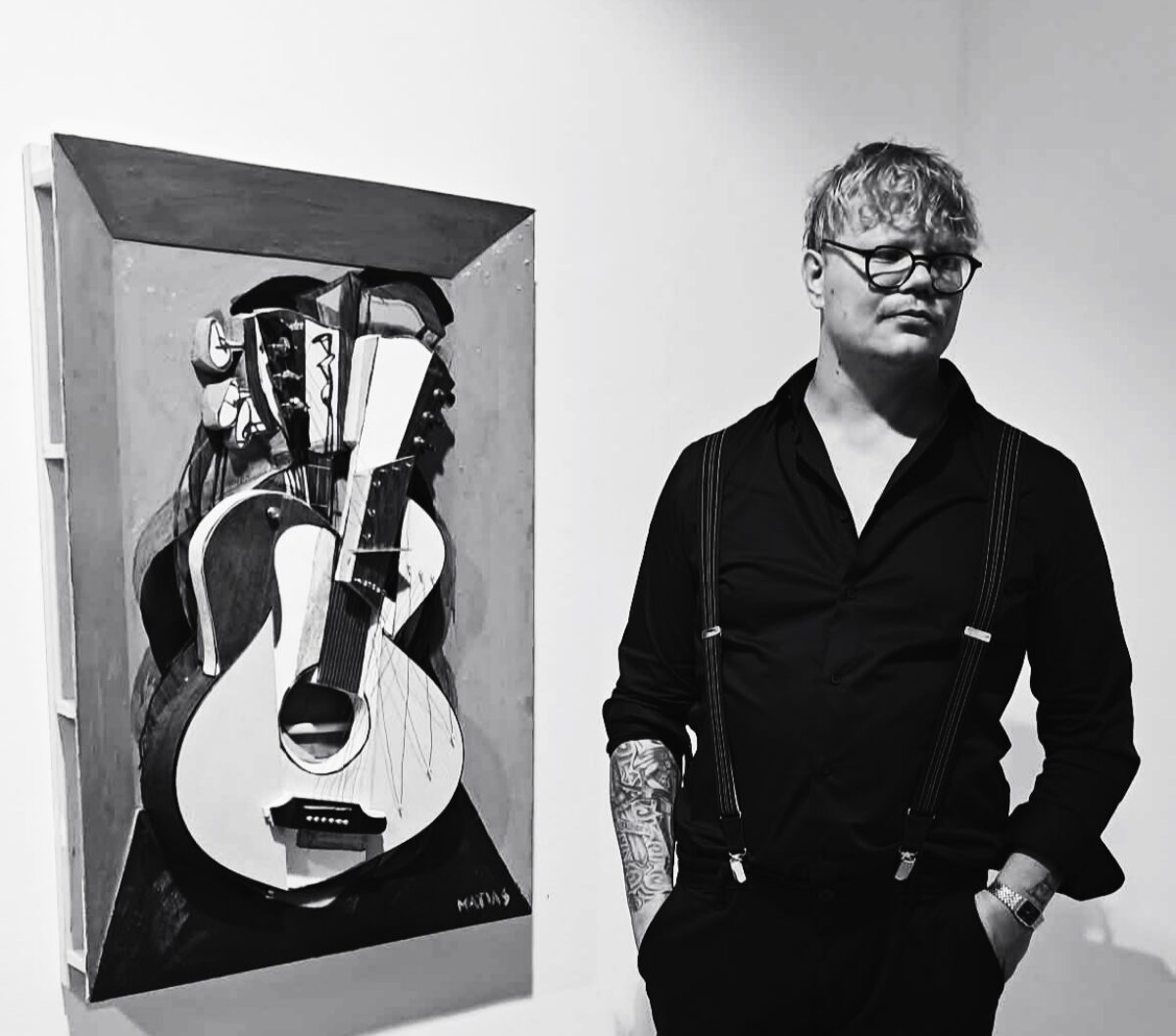
The article Hypercubism, Part III constitutes the third part of the philosophical framework of Hypercubism, which examines the manifestation of theory in artistic work and the development of expression. The text is based on a long-term personal research process that combines visual artistic work, philosophical thinking, and reflection on perception and reality.
The article describes how the key principles of Hypercubism, such as multidimensionality, the relationship between reality and experience, and the role of the mind in the construction of perception, are manifested in the practical artistic process. The material is paintings and studies completed in 2020-2026, through which the transformation of expression towards a freer and more multidimensional approach is analyzed.
The text traces the evolution of artistic practice from a representative and structurally controlled expression towards a more intuitive and conceptually broader form. The process also includes critical stages that have guided the reassessment of thinking and deepened the relationship with the philosophical foundations of Hypercubism.
The article shows that Hypercubism functions in practice as an influential model of thought and perception, shaping both the artistic process and the way we structure reality. It functions as an applied and researched part of the broader Hypercubism whole.
PREFACE
Love can change, people can disappear, life can be different today than it was yesterday, and become completely different tomorrow.
Yet reality itself remains unchanged That is why I seek its deepest truth. I can trust that it is the only one that will last.
This text is dedicated to all those who have helped me achieve the things I have achieved over these ten years. The theory of Hypercubism would not exist without your understanding, acceptance and love.
I would especially like to dedicate this text to Octavian Iordache, who has shown me that this has not been in vain.
I. INTRODUCTION
II. INTRODUCTION II
III. RESEARCH ON CUBISM
Cubism studies through paintings
Theoretical research
History of Cubism
Cubism and Hypercubism
IV. RESEARCH ON HYPERCUBISM
Diagrams of a hypercubist work
Process description; Guitar II
Hypercubist studies
Theoretical research
V. DIMENSIONISM
VI. POLYTOPISM
FINAL WORDS
Hypercubism has been given its framework, and its rough lines have settled in place. The project of several years can now rest and breathe a little, and the research continues with painting. Writing the theory has been interesting, to say the least.
Although Hypercubism may seem very absolute at first glance, it nevertheless invites artists to examine and develop this new way of thinking. Hypercubism offers a method and regularity, but does not eliminate creative perspectives or applications for its implementation. However, everyone has a personal way of thinking and seeing and experiencing reality as they feel is best for themselves. This would also be desirable, at the very least.
Hypercubism, Part III, offers an artistic application of the written philosophy. However, it is good to return to the first part after this part and examine it as a process. Just as life is circular, so too Hypercubism manifests itself as a circular process. The first writings will certainly appear in a different light after this article.
Once the final Hypercubist studies are complete, the artistic work on Hypercubism will begin in earnest. The next step is also to explore Octavian Iordache’s idea, Hypercubism of Hypercubism, or 8D art.
I wish everyone rewarding reading moments, great insights, and curiosity.
Signature
Anssi Matias Miettinen
21.4.2026
Tampere, Finland
REFERENCES
Aurasmaa, A., Bergström, K., Donner,K., Jokinen,T., Lahti,J., Räsänen, E., Törmä,M., Viljasaari,M. & Väätäinen,M. (2015). Perspektiivi kuvataiteen historiassa. Toim. Vakkari,J. Gaudeamus.
Al-Khalili, J. (1999). Mustia aukkoja, madonreikiä ja aikakoneita. Suomentaja Karttunen, H. Gummerus Kirjapaino Oy.
Honour,H., Fleming,J. (1999). A World History of Art (uudistettu laitos). Suom. Itkonen-Kaila, M., Kokkonen,J., Mattila, R., Palin, T. & Sauri.S. Otava.
Kaku, M. (1994). Hyperspace. Oxford University Press, Inc.
Miettinen, A. (3.5.2018). Kuutioiden keskellä. Valkoinen huone.
Matias, A. (2020). Vain eläin, joka osaa puhua. Kirjapaino Bookcover Oy.
McGivern, H. (2018, November 7). When the avantgarde met E=mc2: The story behind dimensionism. The Art Newspaper.
Miettinen, A. (2024). Kuution sisällä (Opinnäytetyö, SAMK). Theseus. https://www.theseus.fi
Miettinen, A. (2023). Mikulandskán tutkimuksia. https://www.anssimatias.com
Miettinen, A. (2022a). Ulottuvuudet puhuttavat. https://www.anssimatias.com
Miettinen, A. (2022b). Ulottuvuudet puhuttavat II. https://www.anssimatias.com
Iordache, O. (2006). Polytopism Manifesto. https://www.polytopism.com
Sirató, C. (1936). The Dimensionist manifesto. Paris.