History of Cubism
One of the most significant works that gave rise to Cubism is probably Picasso’s Les Demoiselles d’Avignon from 1907. The painter himself drew inspiration from the works of Paul Cézanne (1839–1906) and Iberian sculpture, but the elements of the work were also strongly influenced by African sculpture. In this work, Picasso created a new way of depicting humans and anatomy in the form of diamonds and triangles. The work became significant and groundbreaking, paving the way for a freer way of dealing with space and form, but also breaking away from Western regularity. The work was considered a major intellectual breakthrough. However, the work was not only considered groundbreaking, but also deliberately ugly (Honour & Fleming, 1999. pp. 775,778.)
After painting Les Dames d’Avignon, Picasso met Braque around the same time, after which they worked together for several years, developing Cubism at the same time. The work and the similarity of the works had become so intense that they could not even tell which of their works was painted by whom. The works called Faceted Cubism from 1906–1909 included an abstract approach and features familiar from Cézanne, such as inclined surfaces and partially overlapping planes. This was followed by the phase of Analytical Cubism between 1910–1912, where the works were fragmented into parts, even in a very abstract form. The work was analyzed and rebuilt into an image corresponding to the idea. Synthetic Cubism was born between 1912–1914, when the abstract way of making returned to the representational. Flat and colored forms were accompanied by signs and imaginary lines of forms that specified the work. (Honour, 1999, pp.786-793.)
The mathematician Riemann’s new perspective on geometry also interested the Cubists at the beginning of the 20th century. Riemann’s non-Euclidean geometry appealed to the Cubists as it nullified the linear perspective system, which allowed them to think about space in a new way. A space of four or even more dimensions was created. This space also symbolized the freedom of artists. (Bergström, 2015, p.322.) (Miettinen, 2024)
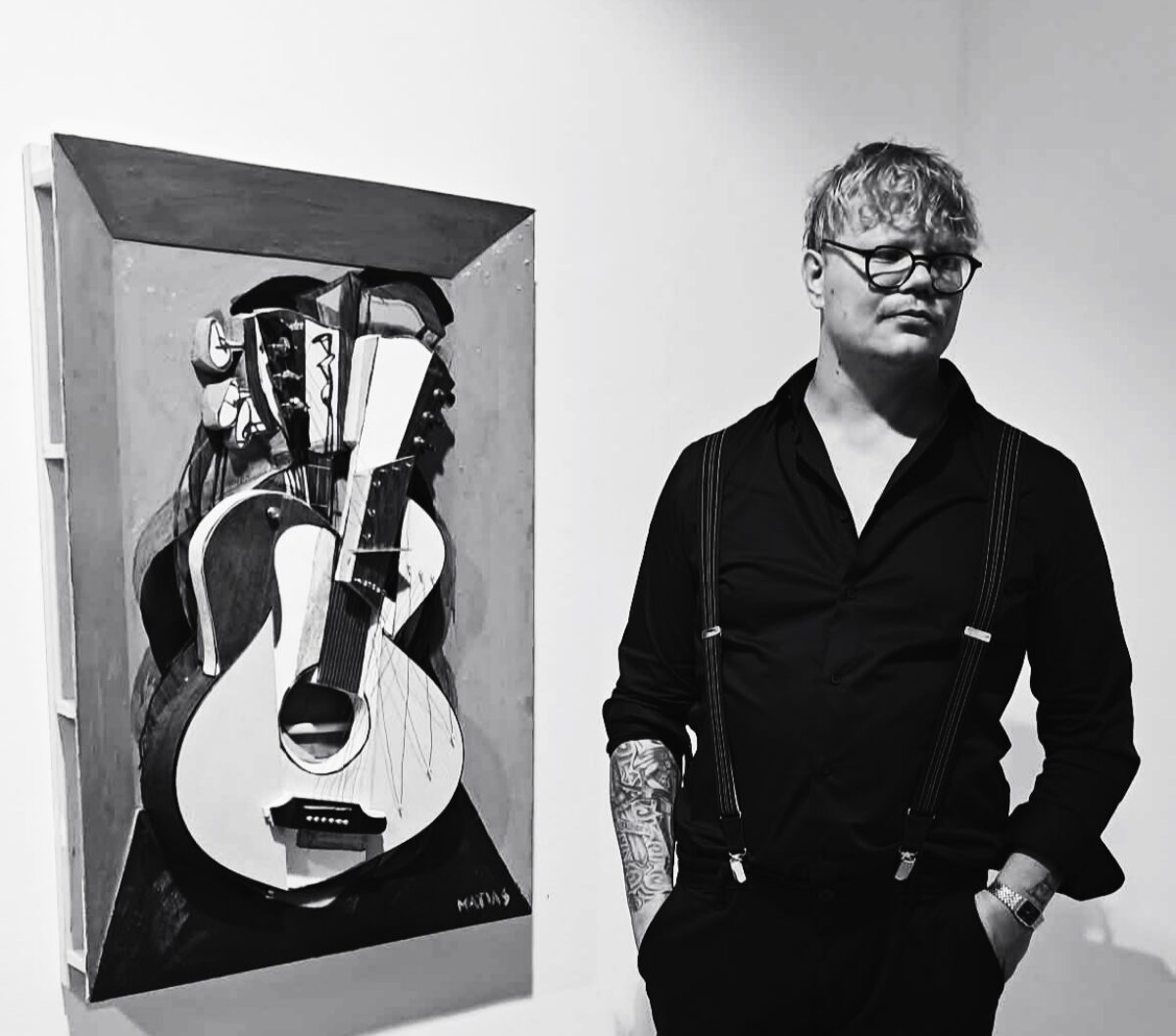
Also noteworthy are Picasso’s three-dimensional guitar experiments, which he made in the years 1912-1914. Picasso used cardboard and wire in his sculptural guitars, but these remained at the experimental stage. Picasso continued his work with Cubism, painting on a two-dimensional surface. Hypercubism continues in Picasso’s footsteps, bringing three-dimensionality as a central part of the structure of the works.
Whether the early Cubists discovered the fourth dimension is up to the interpreter. According to the principles of Hypercubist philosophy, a four-dimensional work cannot be realized on a two-dimensional surface. Therefore, Picasso’s sculptural guitars are the only works that can be considered 4D art. In Hypercubism, this four-dimensionality is made structurally and visually visible through both theory and practical implementation.