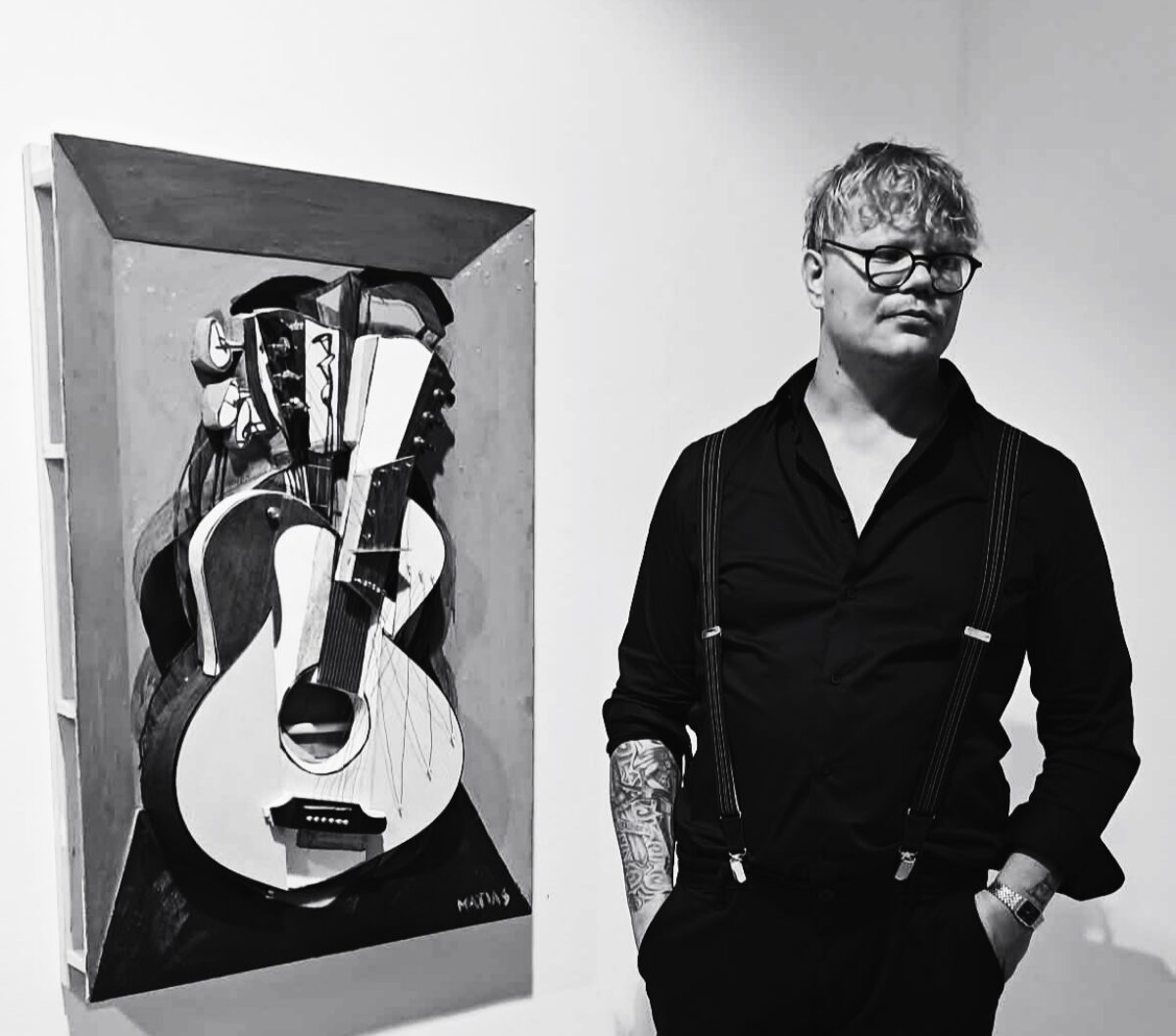
Polytopism refers to a way of thinking in which complex structures and phenomena are represented through polytopes. A polytope is a generalization of a point, a line, a polygon, and a body to higher dimensions. In this way, it serves as a structural model for the growth of dimensions. In polytopism, the focus is not on a single form, but on the system between forms. This makes polytopism a method by which complexity can be constructed and structured.
In Hypercubism, polytopism serves as a structural basis. A painting is not just an image, but a polytopic construction in which different dimensions appear as layers, projections, and parallel structures.
Octavian Iordache´s Polytopism
Octavian Iordache’s Manifesto of Polytopism presents a general model in which complexity increases through the addition of dimensions. It defines a developmental path from 0D to 8D and presents this structure as universal across different fields of science and art. In this framework, Hypercubism is situated on the 4D plane, where two-dimensional structures are combined into a multidimensional whole. (Iordache, 2026)
Hypercubism is not just an aesthetic movement, but a visual manifestation of polytopic structure. While Polytopism defines the growth of dimensions theoretically, Hypercubism implements it in paintings. Thus, Hypercubism acts as a bridge between abstract polytopism and concrete artistic form.
Polytopism and Hypercubism
The relationship between Polytopism and Hypercubism is two-way. On the one hand, Polytopism provides a structural framework for Hypercubism. It defines how dimensions can be organized, combined, and projected into a visual whole. Without this structure, adding dimensions would remain conceptual.
On the other hand, Hypercubism concretizes Polytopism. It makes abstract polytopic structures visible in painting, where they appear as overlapping spaces, nested pieces, and fragmented but coherent wholes. Hypercubism therefore does not only use Polytopism, but also tests and develops it as a visual system. In Hypercubism, polytopism is not just a mathematical framework, but a way of reconstructing perceptual reality through multiple dimensions.
At the same time, Polytopism and Hypercubism continue the historical alliance of art and science, in which both seek to interact with each other based on the same invisible structures.