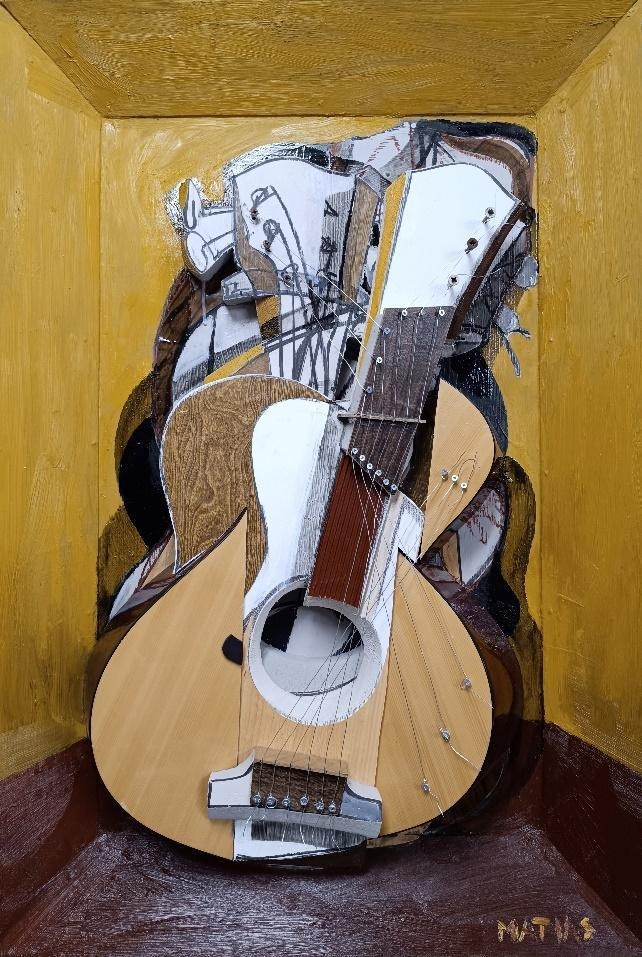
Guitar II –The process description of the thesis shows how the hypercubist thesis is built from the beginning. The structure verifies the dimensions indicated in the diagrams and the interaction between them. In a hypercubist work, the layers reflect the third (3D) and fourth (4D) dimensions, and the base of the work reflects the fifth (5D) dimension.
The three-dimensional bases of the work are handmade from wood, which I have made especially for these works. After this, the base is primed, making it ready for sketching. The sketching is done with charcoal. The image formed during the sketching phase is a light and fast, almost thoughtless process. The sketch is created from free hand movement and unnecessary analysis. At this point, the sketching is a present and almost consciously unconscious process, where the work is guided by experience and understanding of the shape and essence of the guitar. After the sketching phase, the base color and the first collage elements are applied. The collage elements are a DC-fix surface that imitates the wood grain, which is glued on.
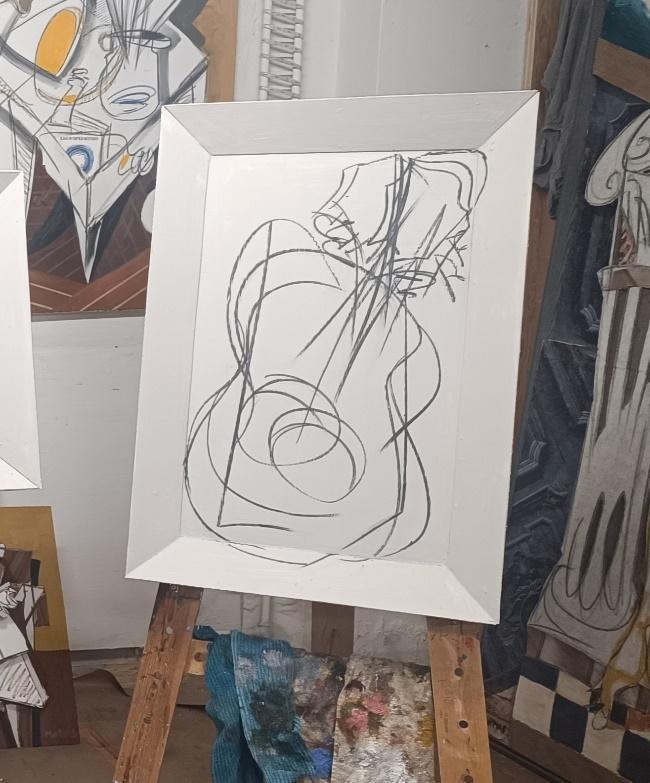
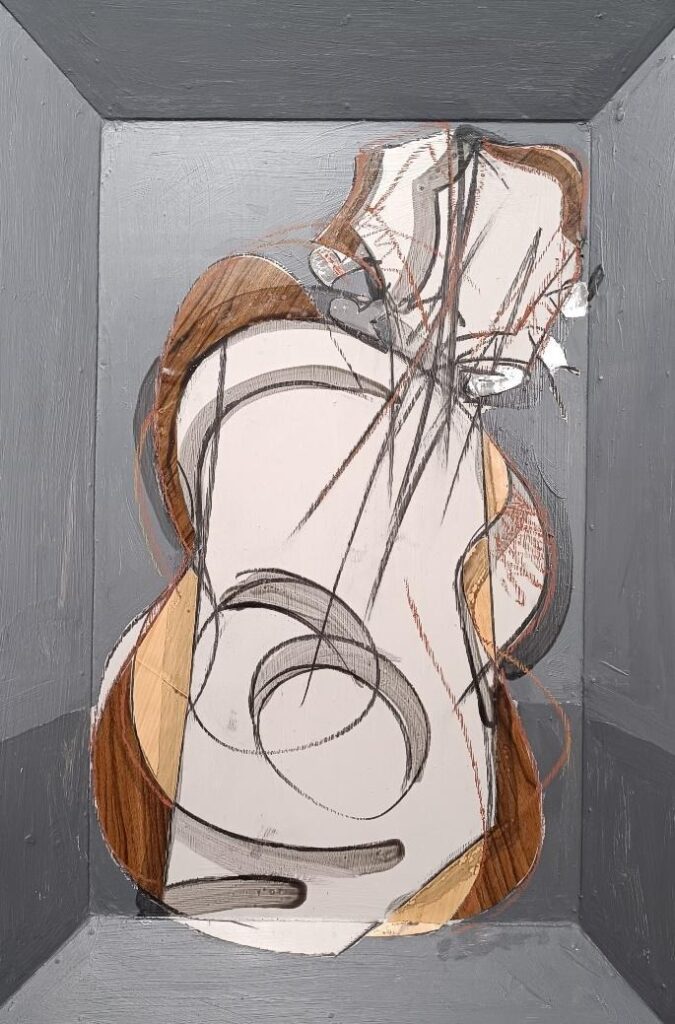
From the very beginning, the guitar is expressed through its recognizable elements. The arrangement of the collages, the different collage materials and the sketch line form the essence of the guitar. The three-dimensional base serves as the basis of the work concretely, but also philosophically. The final work is built on the base according to and guided by the sketched guitar. In this way, the Hypercubist philosophy of fifth-dimensional consciousness gets its visual framework. Just as consciousness is the basis of experience and reality in life, in a Hypercubist work the base is the basis of the whole.
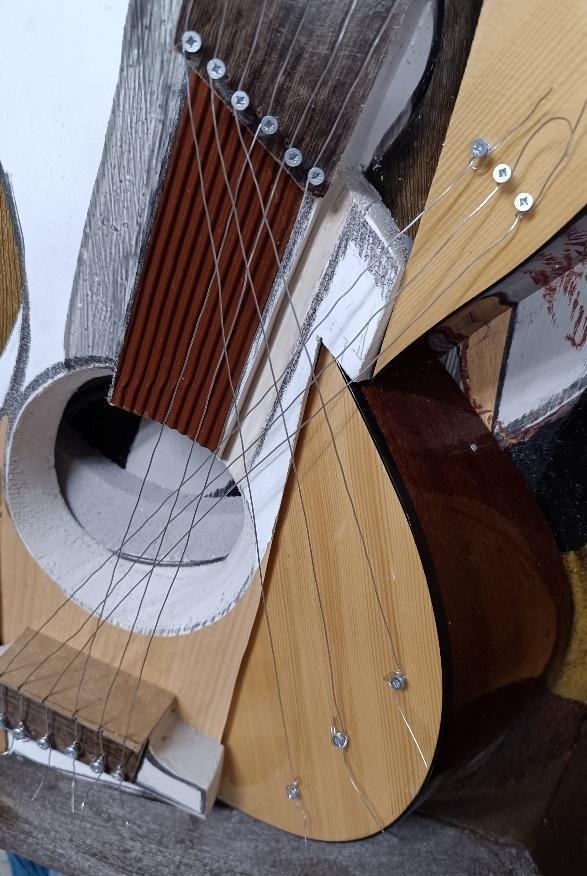
Before the layers, concrete pieces of a real guitar are added to the base, which originally served as a model for the sketch itself. The guitar, from which the observation has been sketched and drawn, becomes part of the work. This brings concrete third-dimensional information and interaction into the work. The work is at the same time an observation and experience of the object to be painted, but also the object to be painted itself, dismantled and reconstructed.
Traditional Cubism used collage to bring out real features of reality, but in Hypercubism, three-dimensional real parts of a concrete object act as fragments of reality. Cubism remained on a two-dimensional surface, while in Hypercubism the painting is three-dimensional. Therefore, in Hypercubism, these concrete parts of objects are called three-dimensional collage, i.e.3D collages.
Once the ground layer is completed, it is the turn of the first layer, which embodies mind and thought (4D). In Hypercubist philosophy, the fourth dimension, mind and thought, is the information and interaction of the third dimension, as it were, a “shadow”. The fourth dimensional layer therefore embodies line and thought, the interpretation of an object.
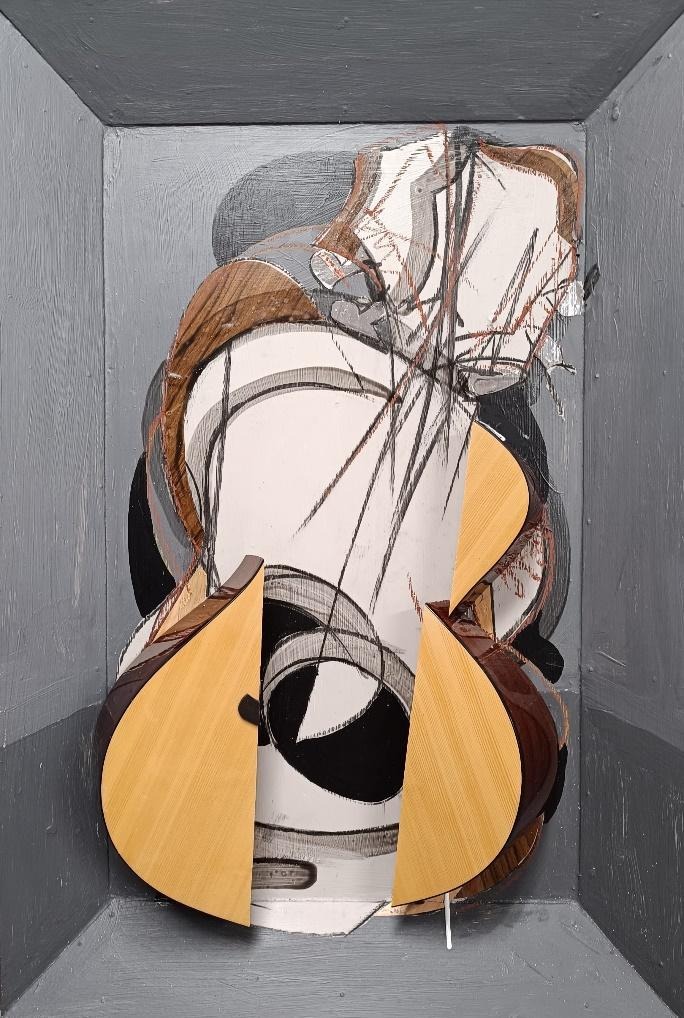
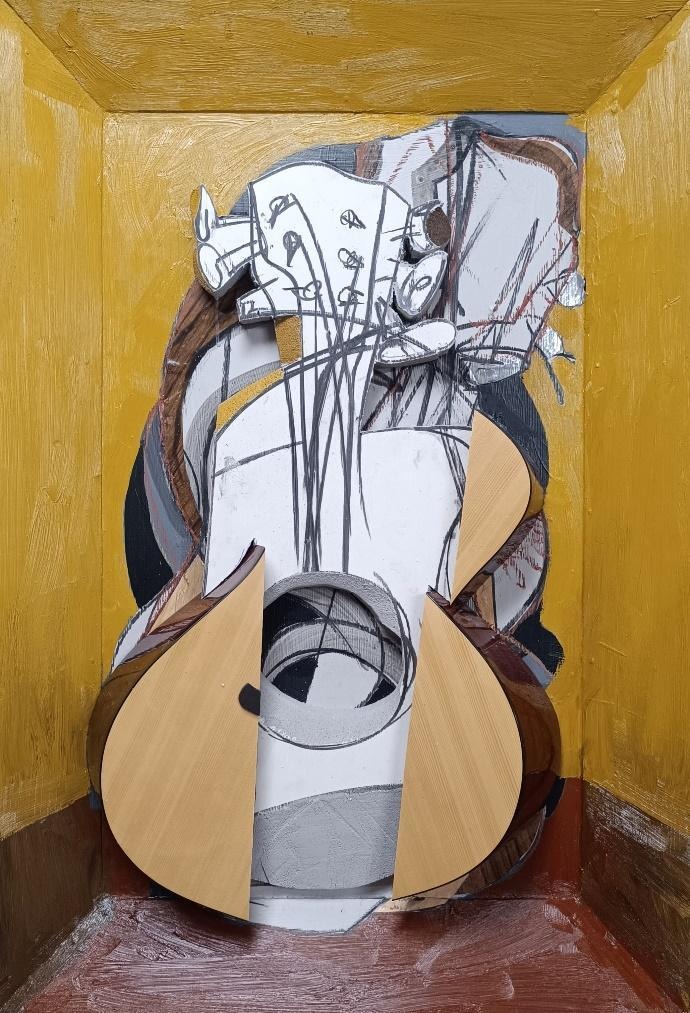
Each level is therefore made into its own work. Even though the lower level is below the upper one, it is still executed as if it were its own independent work. Thus, each level expresses itself in the most hypercubist philosophy possible. The first finnfoam layer is no exception to this.
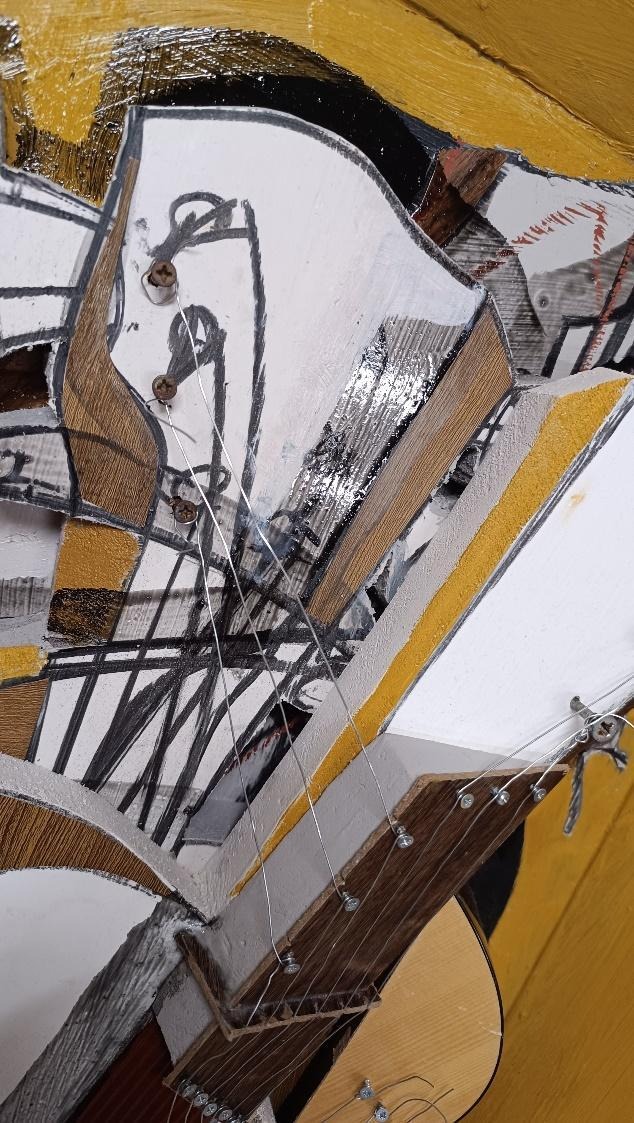
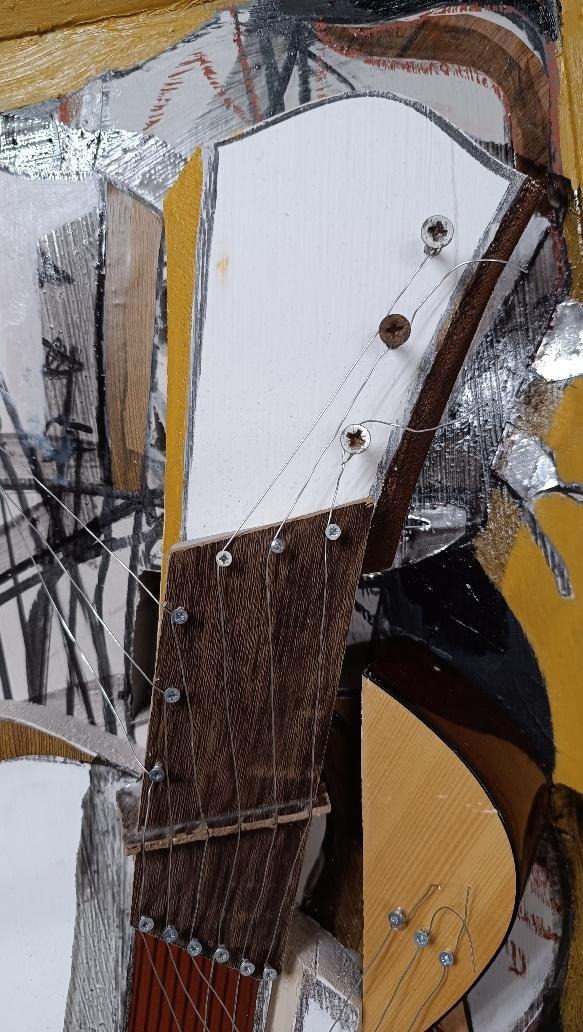
Once the fourth dimension layer has its collage element, we move on to the final third dimension layer. The third dimension layer of finnfoam is placed on the same level as the 3D collage elements, and is also given elements representing the neck of the guitar, as well as the screws to which the strings are attached. The strings cross between the different dimensions, creating tension and interaction between the dimensions.
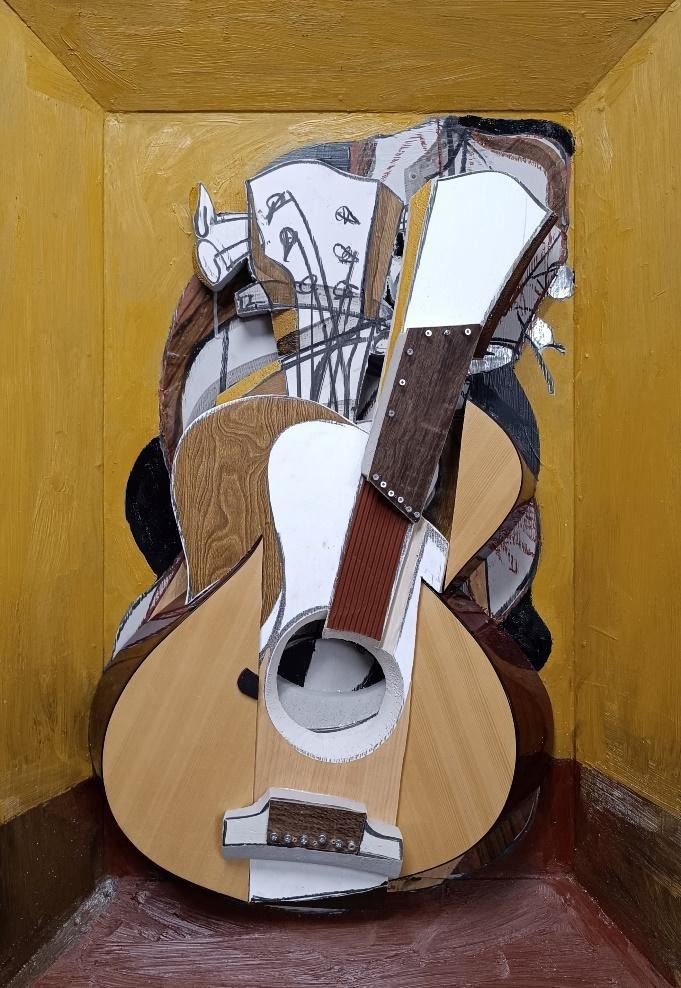
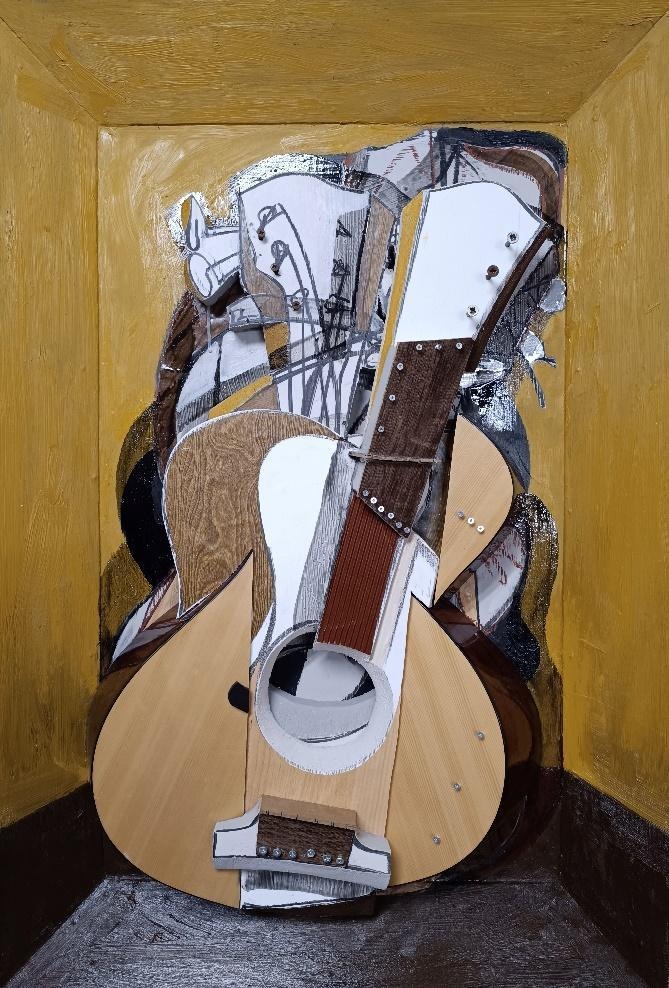
The work also includes shadows added with a medium on top of the oil paint, which express the shadows of the already multiplied forms and the multidimensionality. In the hypercubist philosophy, the shadow is part of the structure of the work. In the work, the shadows appear in three different ways. As painted illusions made with the medium, and as natural shadows created due to the three-dimensional forms. The work therefore creates shadows on top of shadows, both conceptually and concretely.
The finishing touches to the piece include strings made of iron wire, which bring the finishing touch to the piece. The role of the strings is important. They make the interaction between dimensions concretely visible. The guitar necks connect, the strings cross on the surfaces, and the piece becomes its own system.