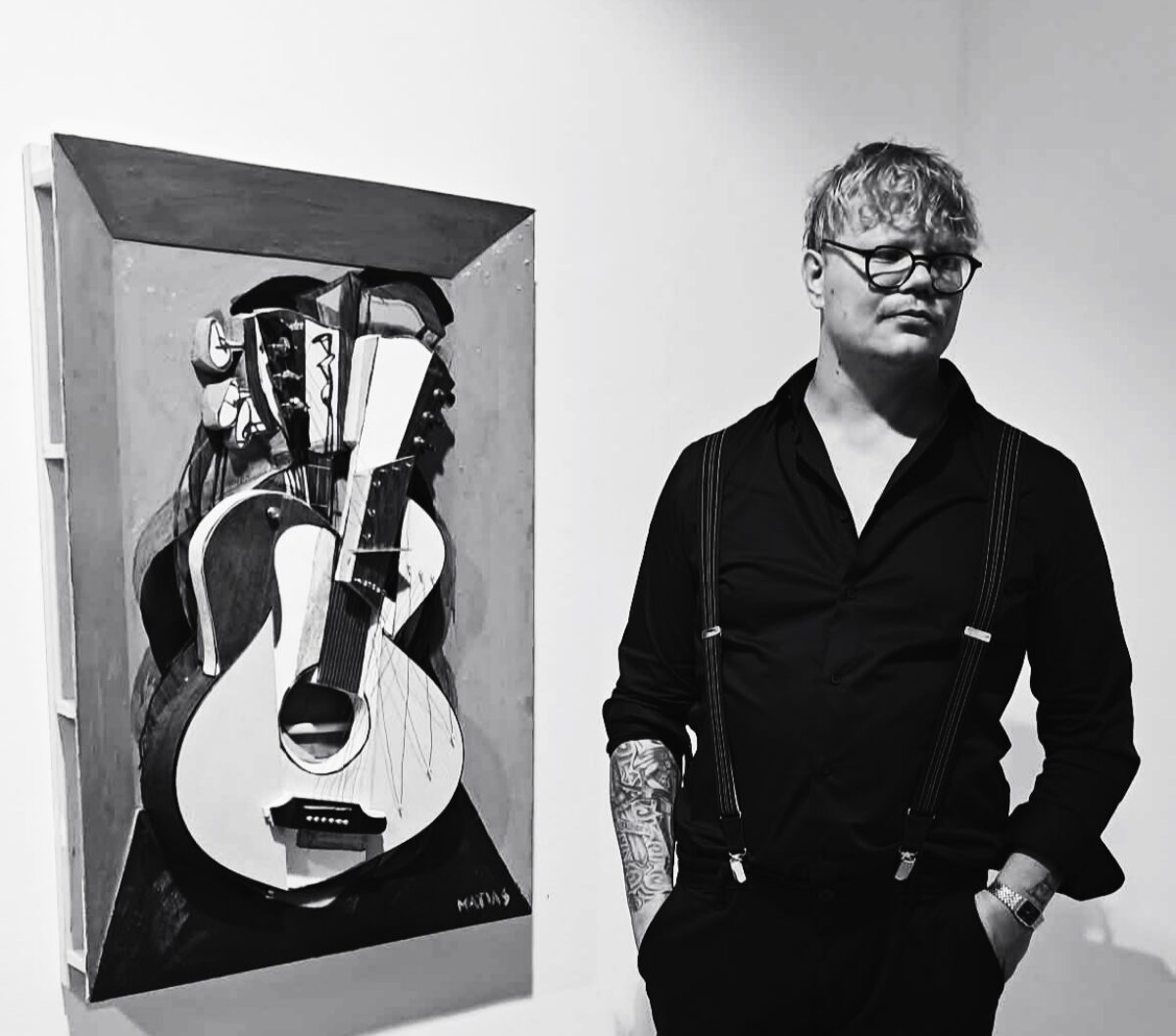
The first real study of Hypercubism was my thesis.Revelation, where for the first time three-dimensionality and dimensional interaction became truly visible. However, it did not implement the ideas of the Hypercubist manifesto exactly, but it strongly anticipated the future. As in the studies of traditional Cubism, the studies of Hypercubism have also been both painterly, but also conceptual.
Studies before the manifesto
Revelation
A little look into the past
In 2023, I was studying in Prague at the local art university, AVU (Akademie výtvarných umění), as an exchange student, and in the summer I met my acquaintance Kimmo Gustafsson, who had a layover in Prague while he was on a football trip to Spain. We met and Gustafsson told me about a new kind of innovative acoustic board material that would be easy to handle and also easy to paint on. The peat acoustic board was manufactured by Konto oy. In addition, the acoustic board would be made entirely of Finnish surface peat and therefore a very ecological alternative for producing art. At that time, I had been developing a new style of painting in my mind, hypercubism, and trying to find the possibility of adding three-dimensionality and relief to my paintings, and the material sounded like a great option for these experiments. We agreed that when we were both back in Finland, we would start experimenting with the material immediately.
The personal exhibition calendar for 2023 was relatively tight, as during the year I took part in two group exhibitions in Prague alone with my new way of painting. When I returned to Finland, one group exhibition awaited me, Art Majaalahti 2023, to which I took my older works. The new types of paintings received new impetus at my then workspace on Salhojankatu, where the outlines made with charcoal pencil and backgrounds painted with oil were combined with a collage technique made of recycled wallpaper, newspaper and fabric materials. I had already used these elements in collage in previous years, so working with the materials was familiar. There was also an exhibition planned at the Pori Saskioiden Gallery in Pori, which went by the name “Metamorphosis”, and at the Galleria Ronga in Tampere, where the first series of works created from the acoustic board material made from the surface peat was called “Silenced acceptance”.
In 2024, I was scheduled to graduate from Satakunta University of Applied Sciences as a visual artist. The final project consisted of two parts, a painting final project and a written part. The written part of the final project dealt with my journey as a painter, but also my cubist reflections in their entirety. I also managed to write a small taste of my reflections on dimensions in my thesis, and I wrote my personal views in the form of a theory, which goes by the nameCube, theory of dimensions. This would also serve as the basis for future hypercubist paintings and the manifesto. The writing can be viewed in my thesis titledInside the cube (2024).
Technical implementation
Revelation painting is a whole that combines collage, oil painting technique and relief with three-dimensional shapes. The work is inspired by themes prevalent in our society, but also by stories and perspectives from the Bible. The work is 200x400cm in size, and its depth is approximately 10 cm. The work has considerable weight.
The production of the work began with material orders, which were easily accomplished by ordering acoustic panels from Konto Oy, and the material arrived quickly by freight to my workspace. I had previously received recycled materials from a construction site, such as cardboard and corrugated cardboard as the background panels for my future acoustic panel works. So, I first had to build a base for the work from cardboard sheets and wooden slats to keep the acoustic panel both straight and in place. The cardboard was first taped together, after which the acoustic panels were glued onto the cardboard using wood glue. After this, a wooden frame was built, onto which the whole formed by the cardboard and acoustic panel was glued. This would keep the work straight and reduce the life of the work. In terms of hanging the work, it was also important to make the frame and background panel strong, as the work would weigh several tens of kilograms.
When the background structures had dried, it was time to start sketching the work itself. Due to the three-dimensional shapes sought in the work, two layers of acoustic board were used. The first layer outlined the future sculptural points of the background and the structures, which also served as the technical background of the work. The top layer included the figures and foreground elements of the work. At this point, the work already built a large staged impression in itself, where things happened on different levels. The figures were made with spray paint and charcoal pencil.
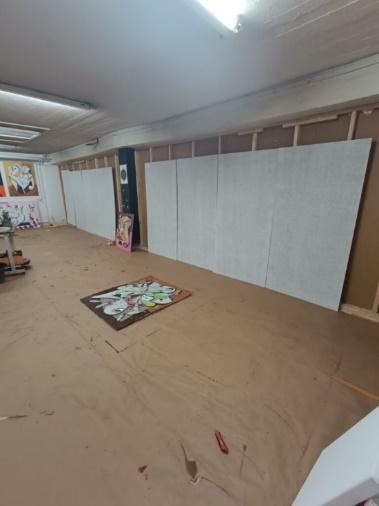
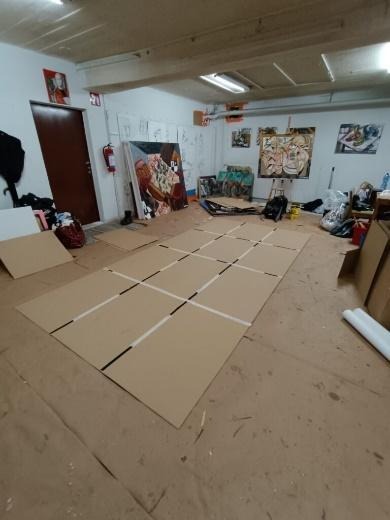
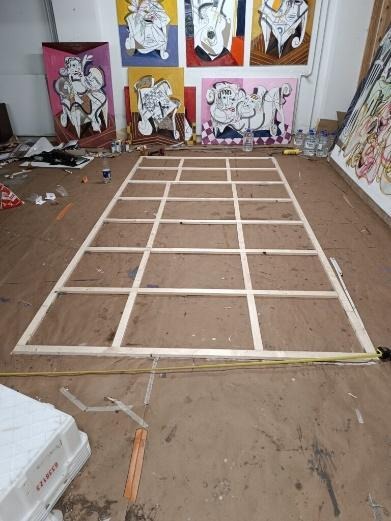
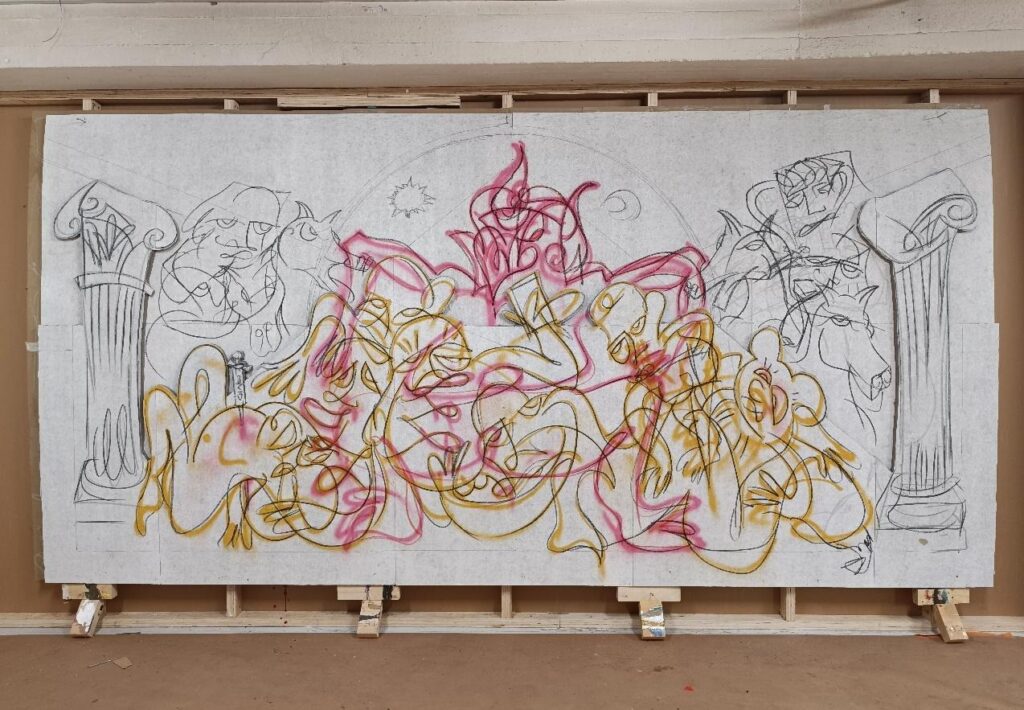
After the outlines and contours, the work began to be carved, which strengthened the recesses and three-dimensional shapes. Because the surface of the acoustic board breaks when cutting, a chewy, crumbly material is revealed underneath, which decays away from its structures. For this reason, each carved area had to be treated with wood glue, and a suitable piece cut from cardboard was glued onto these, which also made it possible to paint on the area in question later. An intact acoustic board can be painted after simply treating it with gesso, but if the material is carved, the carved surface must be “sealed” with glue, for example, and to obtain a smooth surface, cardboard, for example, must be used in addition.
The work also received old wallpapers to create the illusion of space, collage elements made from old clothes, and an oil painting to create a texture depicting the waves of the sea on top of the floor grid and the dome seen in the picture. The characters also received elements of human faces from old posters.
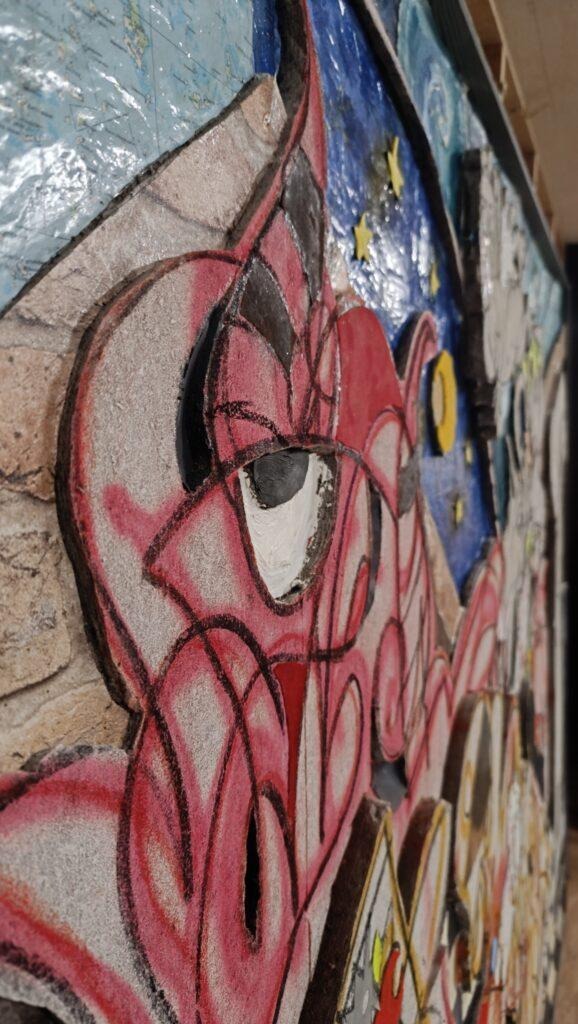
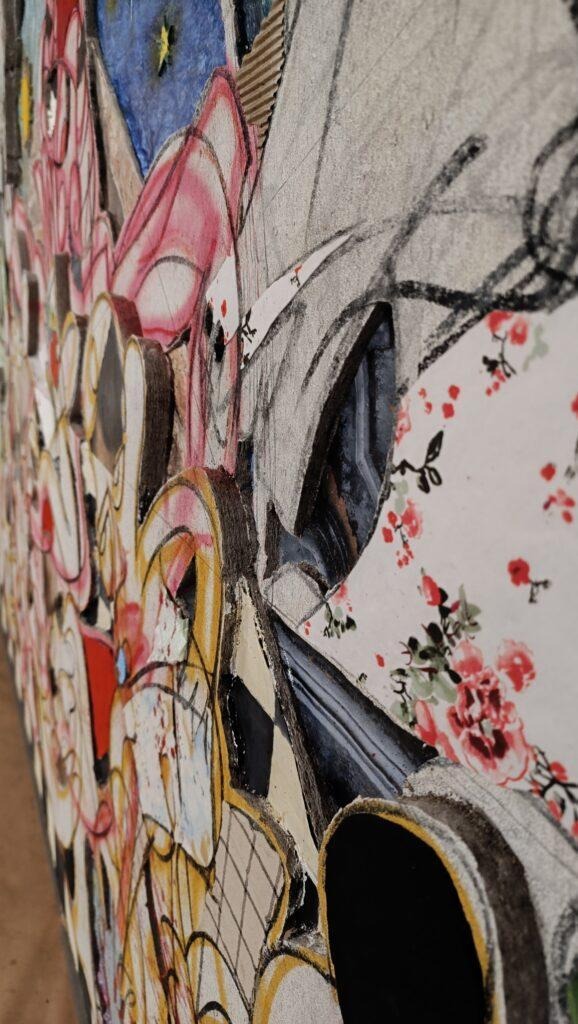
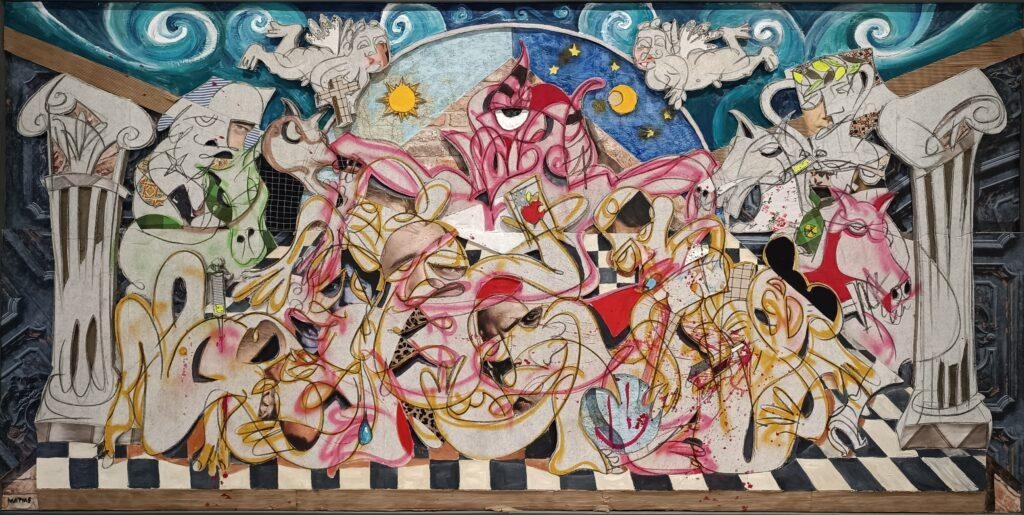
After the work was completed, to enhance the three-dimensionality of the work and the play of light and shadow, frames were made of composite material, which fit the work as if it were a natural fit. Producing the work was a versatile challenge in terms of its size, but also in terms of its weight. Without lying, the weight of the work with all the materials may be 50-60 kilos, and working on it alone in the studio, sometimes horizontally and sometimes vertically, made producing the work a physical athletic achievement. The work was on display at our final exhibition called Liminal, at the Mältinranta Art Center in Tampere.
Personal reflection and external perspectives
I have to say that in retrospect I am very pleased with the work, but when I was making it I would have liked it to be my first hypercubist work. The physical production of the work was an effort in itself, but the mental disappointment of not being able to express my thoughts at a level I thought was sufficient was enormous. Although I like the work, I still crave much more dimensional views of my thoughts in my future works. Fortunately, these new works are already making their way in the form of theses at the moment. The Hypercubism Manifesto will be published in early 2025.
The audience’s reaction to the work was nice. I think that the work will bring each viewer an outcome that is based on their personal interpretation.
The work was also mentioned in an article in Satakuntan Kansan, which warmed my heart. Comparing the elements in my painting to the masters of the time certainly brought and still brings warmth, but it also counterbalanced other somewhat questionable actions and comments I experienced while painting the work. (Miettinen, 2025)
Roses on a bowl at the table, 2025
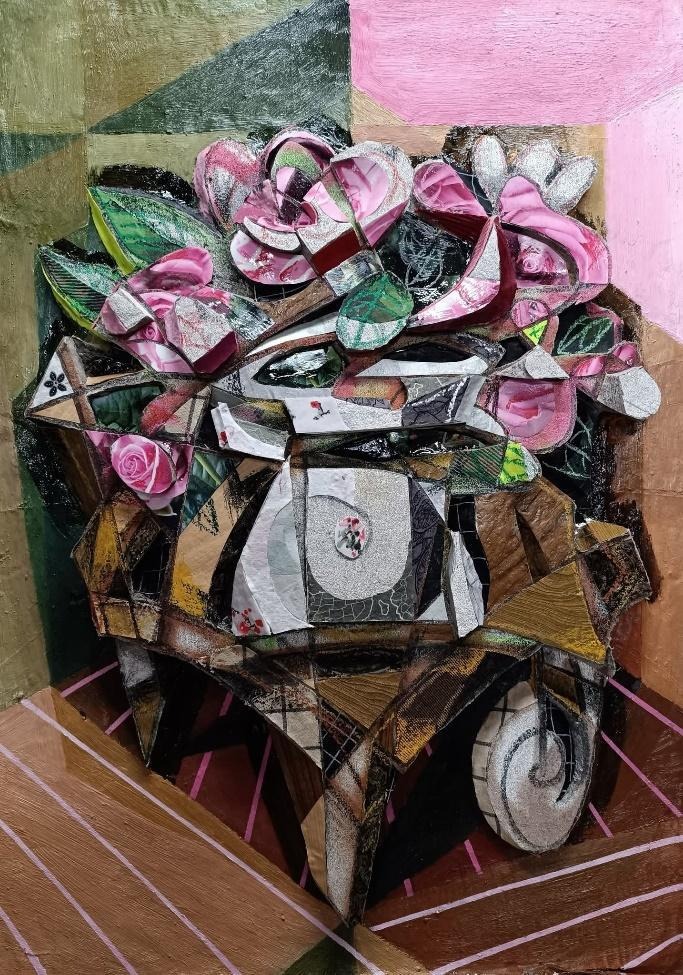
Roses on a bowl at the tablethesis is a post-Revelation work that continues the theme of the painting on acoustic board. In this thesis, a photo collage included pictures of roses taken from different angles and in different lighting, which resulted in different perspectives and lights and shadows in the same work. In addition to the photo collage, the work used old clothes, cardboard, paperboard, as well as oil paints and mediums. The thesis was made before the manifesto.
Portrait of a woman, 2026
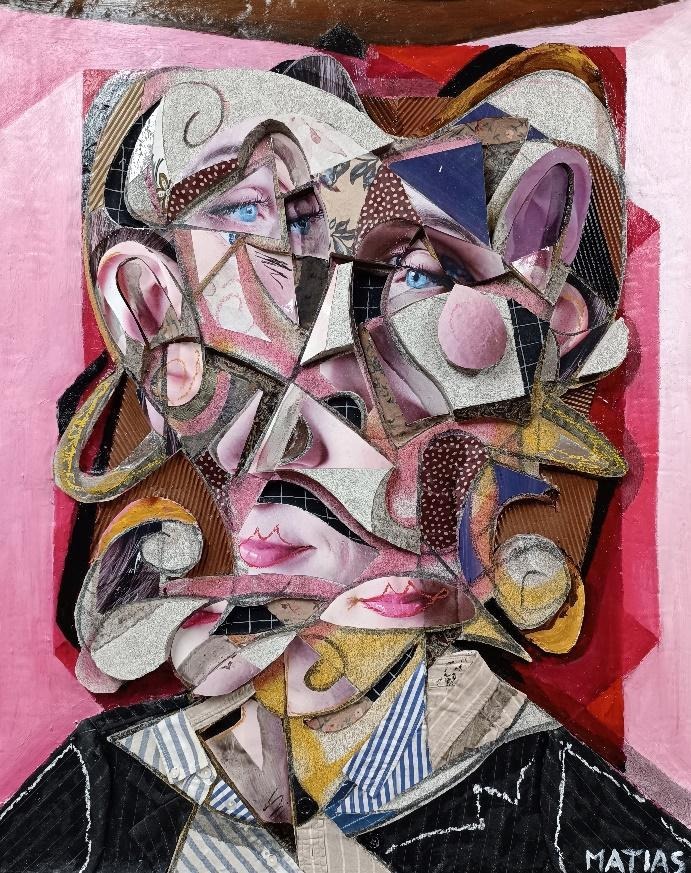
Portrait of a woman The thesis was started in 2025, around the same time as the previous work, but was left unfinished. The recently completed thesis shows images of a woman’s face from different perspectives, arranged in a drawn face shape that has been disassembled and reassembled. The work again uses old materials, such as corrugated cardboard, old clothes, and a photo collage. The recycled jacket used in the work was also worn by the model when the pictures were taken, which again brings a concrete reality to the work.
Studies after the manifesto
While the studies before the manifesto continued the same theme of Revelation in terms of the use of acoustic panels and a somewhat expressive working method, the studies after the manifesto move in a more analytical and structural direction in line with the philosophy of Hypercubism. As shown in the process of the work, the hypercubist studies made on finnfoam accurately express the dimensional and philosophical structure of Hypercubism.
The post-Manifesto studies also involve a three-stage process. Each object is made three times, which in itself constitutes a process. The first work is pure observation and structural analysis, the second work brings 3D collage and clarity of structure, and the third work aims to fully embody the philosophy of Hypercubism in every way mentioned in the philosophy. The studies are divided into the following stages:phase I, phase IIas well asphase III.
Phase I
Phase I includes the first post-manifest studies:Guitar, Chessboard at the table andBanas, apples and mariskool -bowl at the table.
These studies are painted from still lifes, and their purpose has been to express observation in a disassembled and reconstructed form using finnfoam and collage elements. These are the first studies that have attempted to be constructed entirely in accordance with the philosophy and principles of Hypercubism. The materials used have been old plywood from a dresser, old finnfoam insulation from a pizzeria, and old cardboard and clothing.
Guitar, 2025
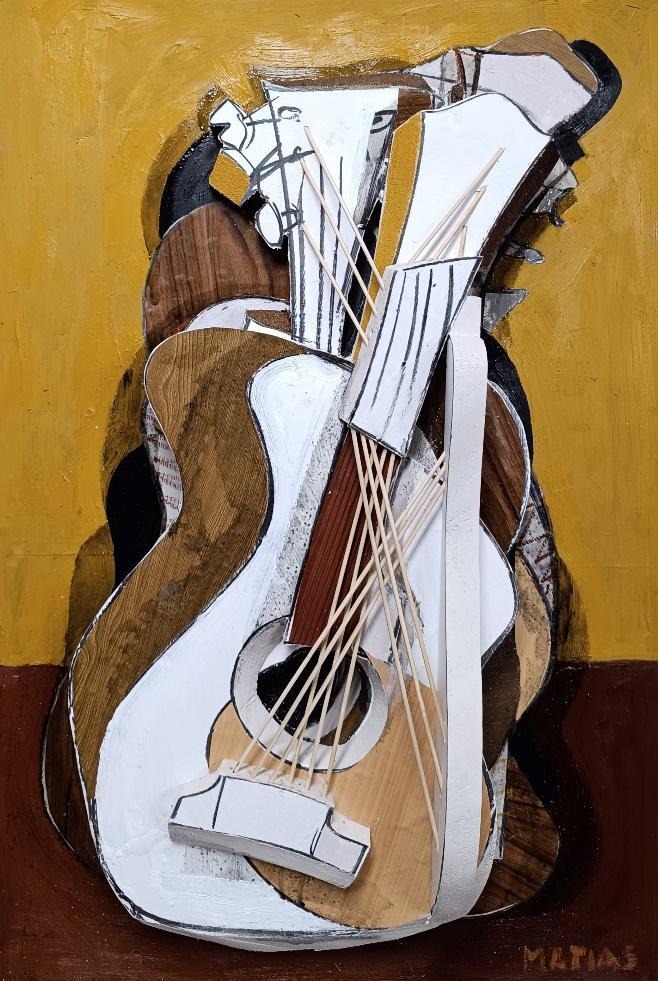
GuitarThe research topic of the thesis has been the multiplication of the guitar, the play of light and shadow, and the search for structural truth. In the work, the tension and interaction between dimensions are realized, and the material choices support the hypercubist working method.
Chessboard at the table, 2025
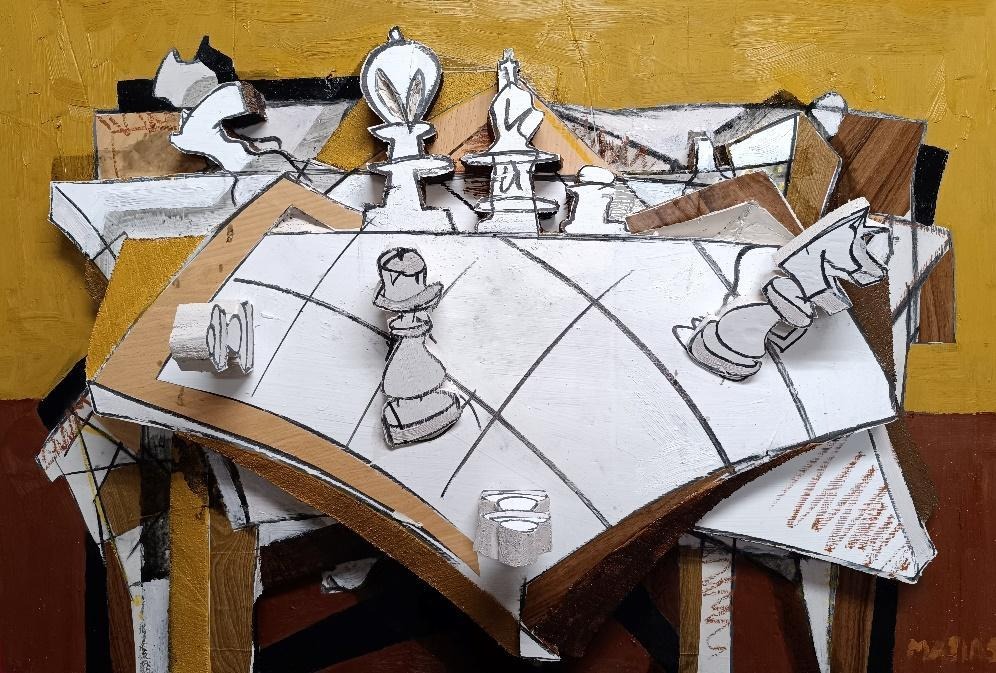
The thesis Chessboard at the table explores the changing perspective on the same plane. Chess pieces are visible from three different directions on one plane, straight ahead, diagonally and from above. The surface of the chessboard stretches and allows the perspective to be viewed from many directions. Chess pieces form the characteristic of structural shadow described in philosophy.
Banas, apples and mariskool -bowl at the table, 2025
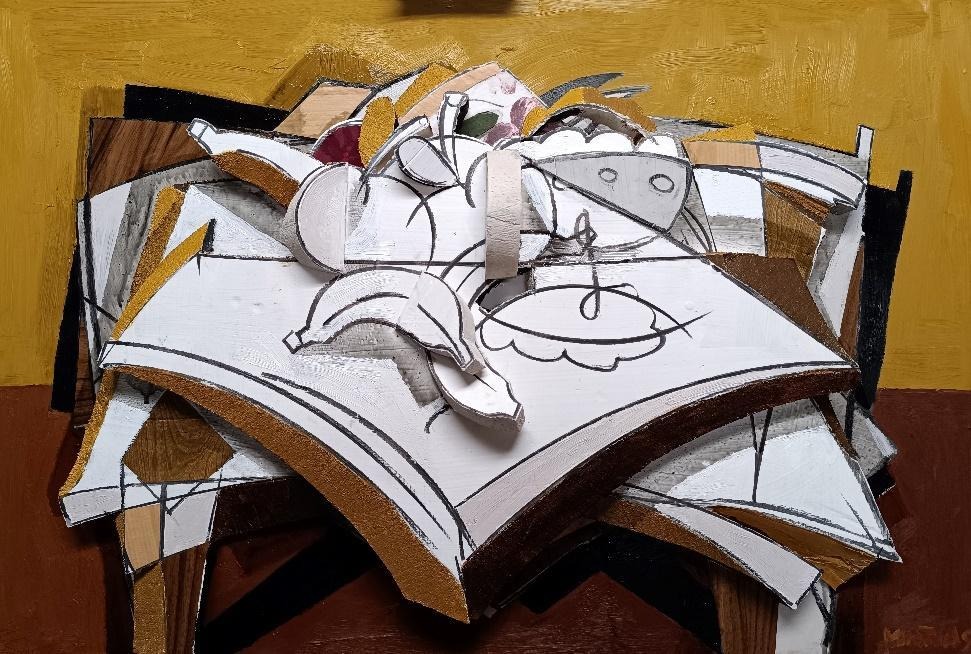
Banas, apples and mariskool -bowl at the table -In the thesis, the tablecloth appears as a collage at the top of the work. Bananas and apples reach out from the work, creating a tension between dimensions. Light and shadow play simultaneously in the work, both painted and through the shadow effect created by real light.
Phase II
This phase further increases the structurality and dimensionality. The works are built on a three-dimensional base, previously shown in the diagrams, which embodies the wall of the tesseract. In addition to the layers, the works receive a 3D collage, which manifests itself as cut parts of a guitar, pieces of a table, and the surfaces of a chessboard. In the studies, the structural truth according to the philosophy of Hypercubism is revealed on an even deeper level in the works of Phase Two. Due to the process, the works of Phase Two follow the observations of Phase One.
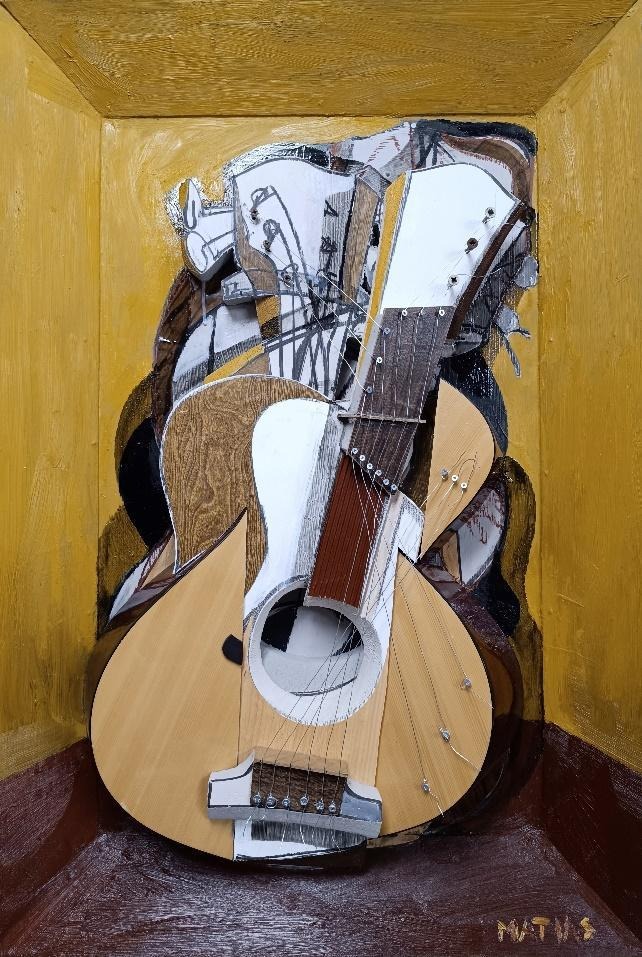
Guitar II, 2026
The Guitar II thesis has been analyzed in detail in the process description. The work fully embodies the principles of Hypercubism. The guitar in the work becomes its own system, interacting with itself.
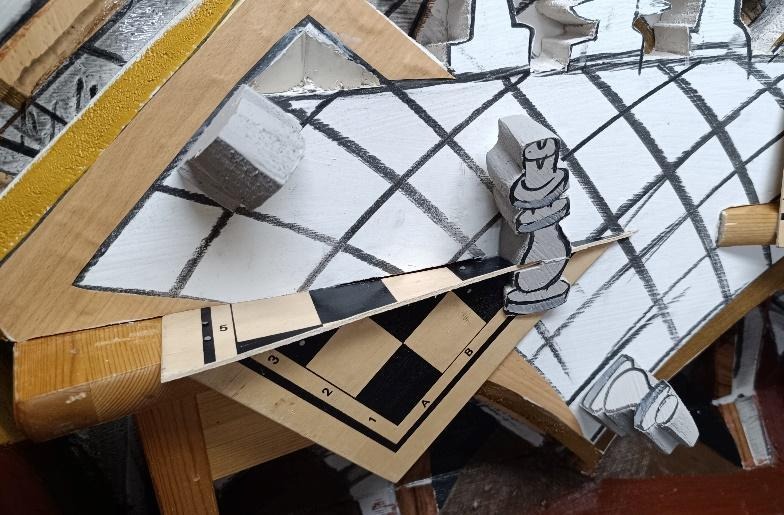
Chessboard at the table II, 2026
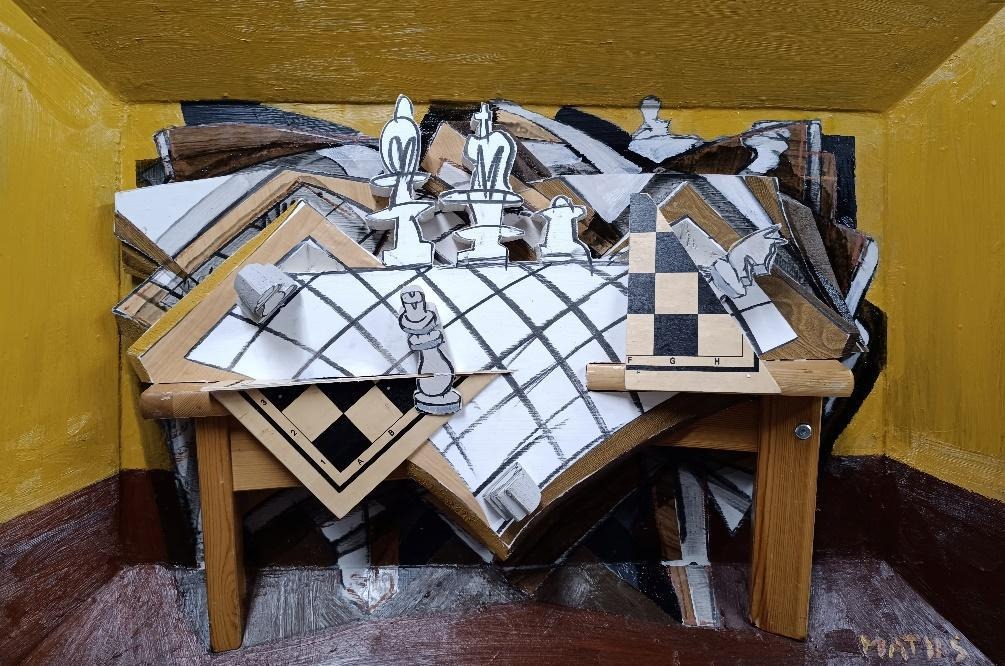
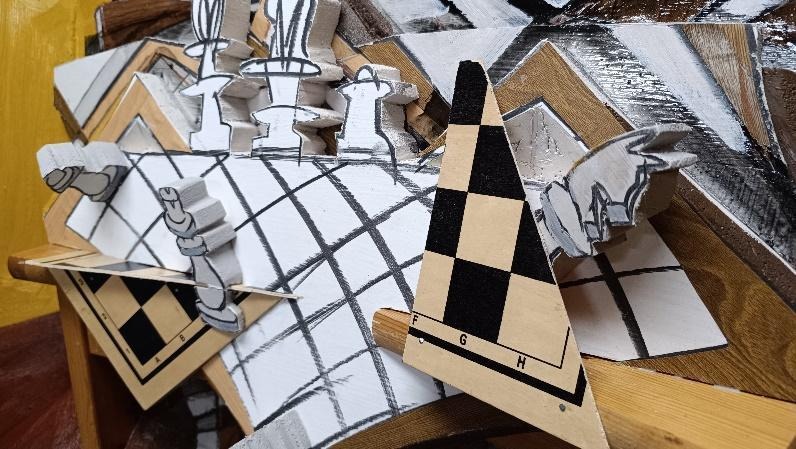
The Chessboard at the table thesis follows the same logic of phase two through a three-dimensional base and a 3D collage. The pieces of the table follow the integrity of the structure with its structures, bolts and joints. The perspective of the chessboard changes in many ways only when viewed from the front. The three-dimensional shapes create shadows on top of shadows. The pieces of a real chessboard create a perception and a mind and thought between the drawn chessboard and reality.
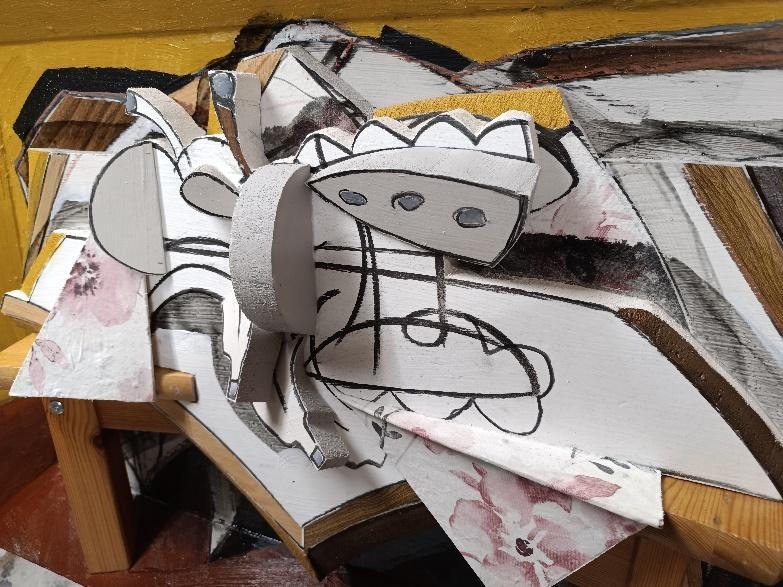
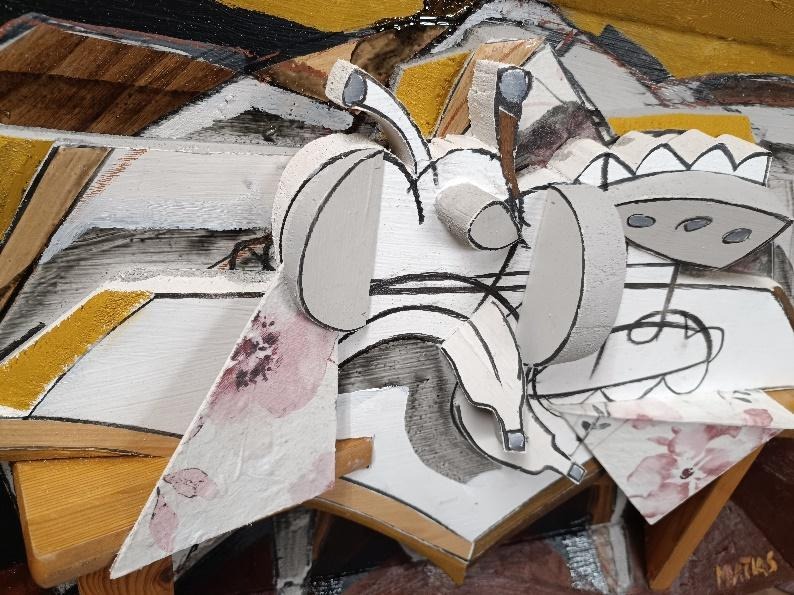
Banas, apples and mariskool -bowl at the table II, 2025
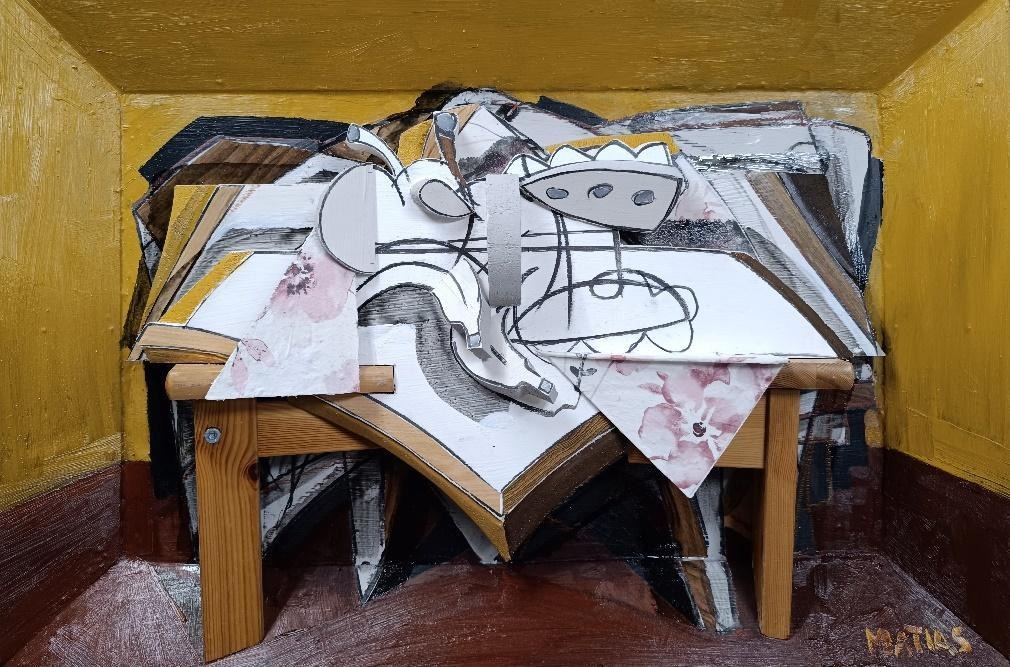
The study Bananas, apples and mariskool -bowl at the table -repeats the structure of phase one. The bananas extend out from the surface, as does the apple. The tablecloth hangs down – the tablecloth has become a collage element and the work, like the previous ones, is placed in a three-dimensional space. The three-dimensional shapes of the work create shadows on top of the painted illusion shadows.
Phase III
Phase III is still under research, and these studies will combine elements of pre-manifest and post-manifest studies. Phase three works will be added to the document at a later date.