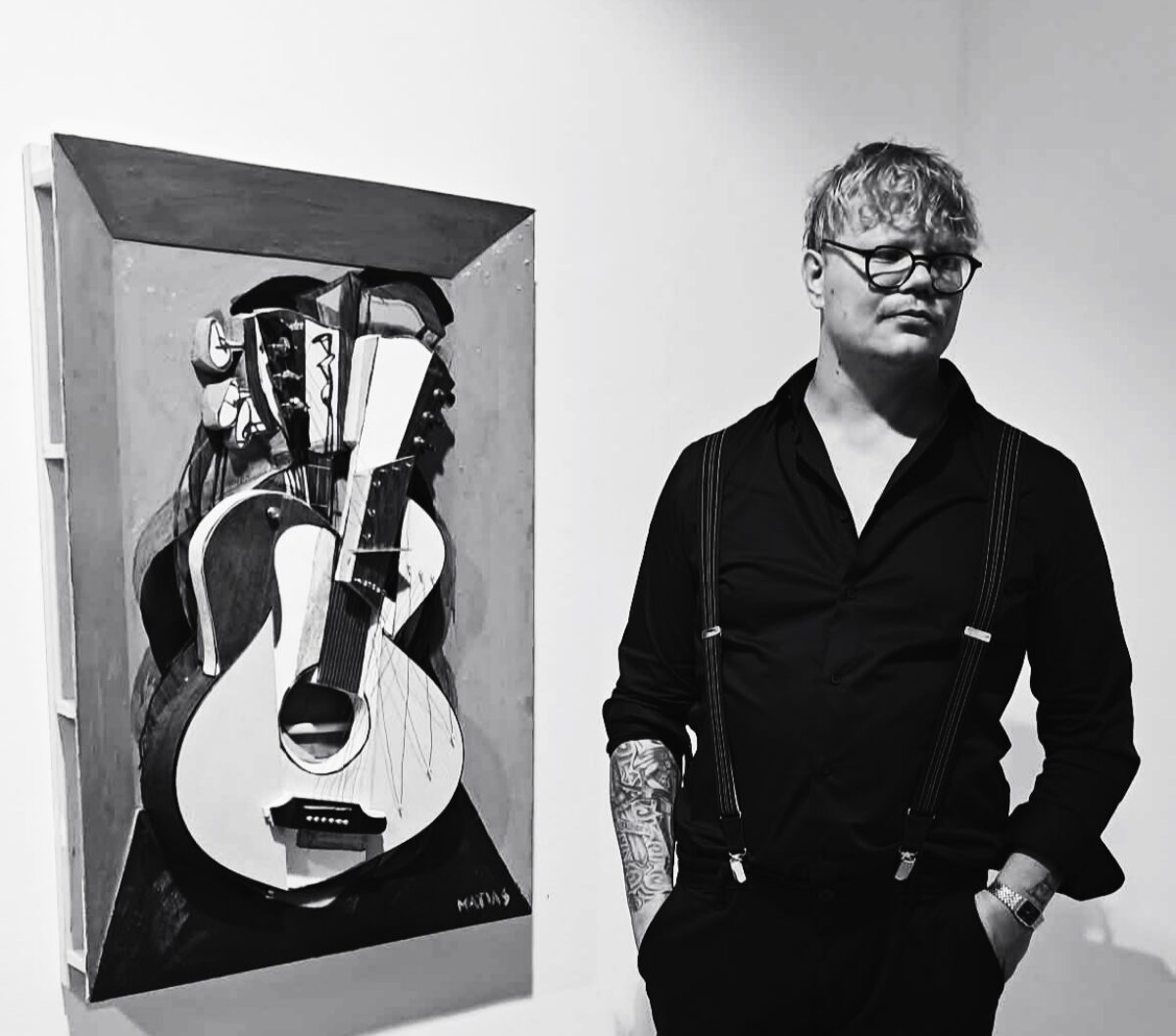
The conceptual exploration of Hypercubism is evident in the manifesto and philosophy. However, it is important to highlight the reflection that emerged in the thesis, when I was somewhat skeptical about whether it was possible to intentionally construct a Hypercubist work in a way that was also theoretically explainable. However, continuous research and work on the subject yielded results.
Theory of Hypercubism
The concept of Hypercubism first came to my mind when I thought of a pattern called a hypercube, where a cube contains another cube inside it, with the cubes connected by lines. A similar cube also depicts a fourth dimension, where the fourth dimension is time. At that time, I had a burning passion and need to create a new cubist style based on that term.
I started by thinking about how I could add another dimension to the already existing cubism. I was able to build patterns and cubist images in my mind that seemed to be overlapping in a vacuum with respect to each other, and where the planes were overlapping each other in layers, and this whole thing was still in a separate space as if it were a still life. However, this created difficulties in how I could get these kinds of shapes onto a two-dimensional surface, or even a three-dimensional surface, so that I could express the idea as I saw it in my mind.
Although I now work with materials that can easily be shaped into three dimensions, the realization of the vision has not yet been as successful as hoped. The basic idea of Hypercubism was also to be able to create a work in which the third and fourth dimensions would be clearly present, but through my recent reflections I have understood that it is nevertheless very challenging in the way I try to reason about it. Of course, in the current way of thinking, my final work, in particular, contains all these dimensions conceptually and on a theoretical level in itself through its subjects and structure, but that does not make it a Hypercubist work. While researching the topic, I met a person named Nathan Larkin Coppedge (b.1982) on social media, who had already launched the concept of Hypercubism in his paintings. However, his paintings and drawings were very abstract and did not correspond to my own view of what Hypercubism could be. We also had a small conversation, where he didn’t say that hypercubism was a fixed style or trend, but that his ideas were expressed in this way. He also launched the concept by using it in his books about his works and in connection with his works.
I don’t know if I will ever be able to achieve the state of hypercubism in my paintings, but I plan to continue researching the subject. Nevertheless, even though I think of the fourth dimension as a dimension of mind and thought, I am also attracted to a slightly mathematical approach to the matter. (Miettinen, 2024)
Although I was still very skeptical about my success with Hypercubism in 2024, now the first post-manifesto studies have taken shape. The manifesto itself explains Hypercubism.
Other people who used the term Hypercubism include Cesare Oliva and Gabriel Shalom.