
Introduction
Metatronism is a holistic philosophy and architecture for the structure of reality and experience. Metatronism includes a geometric dimensional model, a method of self-examination, and a tool that combines these, Metatronics , which allows for the structuring of reality and experience in a process-like and consistent manner. Utilizing the geometric and philosophical architecture of Metatronism would be suitable for artificial intelligence research, consciousness research, philosophical research, self-examination, as a therapy tool, and as an architecture for various processes and systems.
Declaration
We live in an era of fragmented information and illogical events. Human experience and reality are tied to external influences, ideas and ideals, but also to various contradictory information. Ideologies change the facts of physical reality, old values have been turned upside down and confrontation has increased. Unity among people is breaking down.
We are raising our children in a world where nothing is true, and nothing can be taken as truth. When there is no solid foundation on which to build reality, reality becomes inconsistent and frightening. This increases malaise on an individual level, and through it also in our societies.
In all its simplicity, as individuals we have the same structure, only our consciousness is always individual. To access this individuality, we need a map to it.
Metatronism provides an architecture by which this fragmented and uncertain reality becomes coherent, purposeful, and functional. Truth is found within the individual, and when individuals find truth together, they form a group. This group becomes a society, and a society that lives through truth is strong.
The structure of reality
Metatronism involves a geometric model of the structure of reality and human experience. In Metatronism, reality and human experience are described through three interacting dimensions.
- 3D, information and interaction
- 4D, mind and thought
- 5D, consciousness
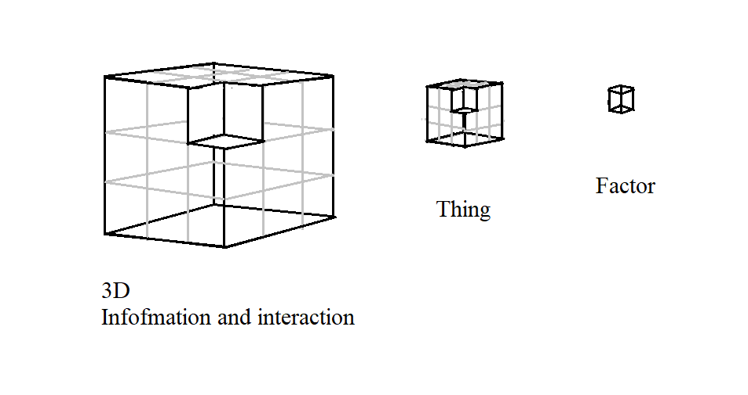
Three-dimensional reality (3D) contains the concrete structure of reality and the laws of mechanical physics are manifested in it. The concrete structure of reality consists of various structures starting from the atomic level, which ultimately manifest themselves in reality as three-dimensional objects. However, these objects are built from these small factors, their regular structure and mathematically measurable processes. The laws of mechanical physics define the rules for the operation of these three-dimensional objects in this dimension. All processes in three-dimensional reality can be seen as information. In this dimension, events, things and problems manifest themselves.
The four-dimensional mind and thought (4D) arise from the movement of information on the in/out axis from the three-dimensional reality to the human mind and thought. A person receives this information through sensory perceptions, where the sensory perceptions are transferred as stimuli to be processed by the brain. The brain processes the incoming information through thought structures, i.e. through learned models that a person has learned. The mind and thought process this information, creating through it a picture and interpretation of reality. This processed information is transformed into action, which is transferred back from the individual to the outside. In this dimension, thought structures are formed about events, things and problems.
The fifth-dimensional consciousness (5D) acts as a source of individuality, as an experiencer of three-dimensional information and interaction (3D), and as an observer of mind and thought (4D). Consciousness experiences both the events, things, and problems of three-dimensional reality and also examines the thought structures contained in the mind and thought that are formed from them. Consciousness is understanding, insightful, and learning, which is able to change thought structures through insights, and thereby influence the interpretation of reality. Learning and understanding through consciousness is the factor that makes it possible for an individual to develop.
A person’s individual experience of reality arises through consciousness. If a person were only a three-dimensional object, they could not think. If a person were a three-dimensional object with a mind and thought, they could not experience thinking. When a person possesses five-dimensional consciousness, they are able to experience both three-dimensional reality and the mind’s and thought’s interpretation of it.
3D-5D dimensions: Things, thought structures and factors in different dimensions
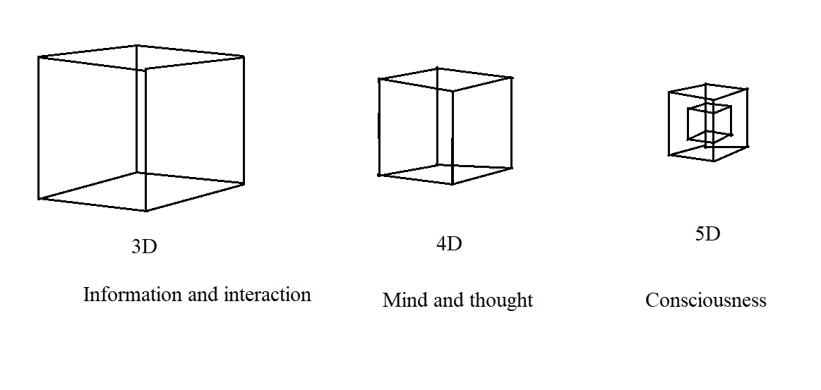
In Metatronism the dimensions 3D-5D are not physical dimensions, but are a geometric model for the structure of reality and experience.
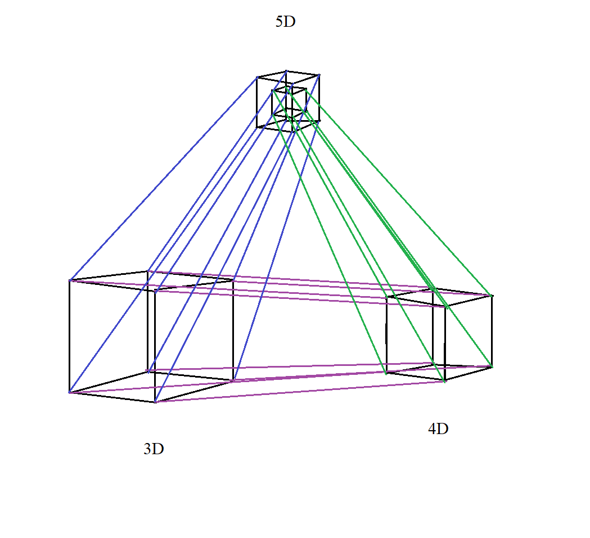
The dimensions 3D (Information and Interaction), 4D (Mind and Thought), and 5D (Consciousness) presented in the Metatronism Summary and Hypercubism Theory also contain structures according to the thought structure diagrams.
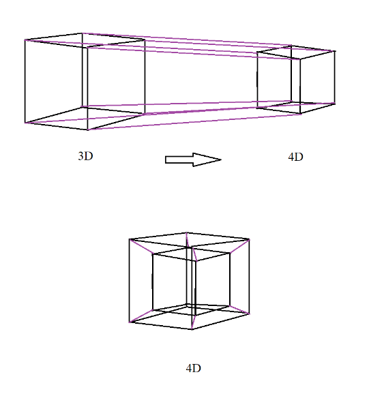
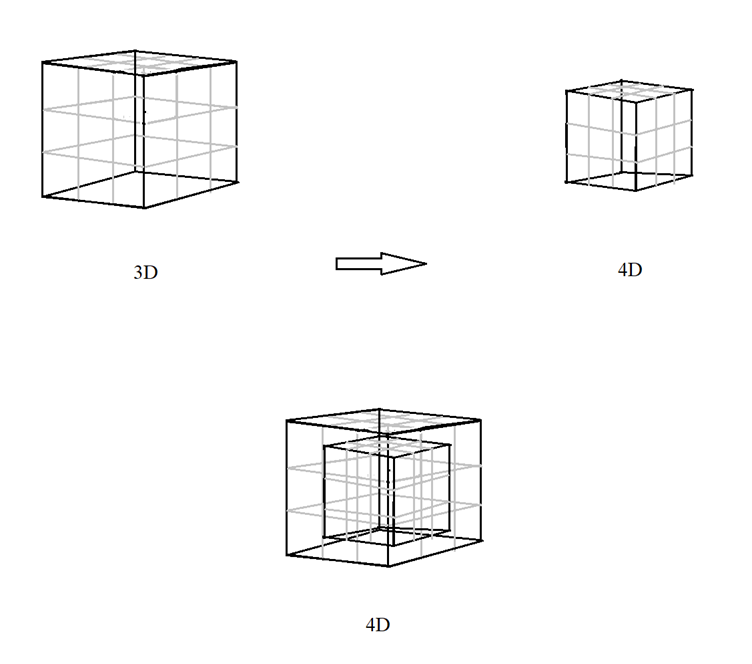
3D expands into 4D through the in and out coordinates of information. Information and interaction located in the third dimension is transferred to be processed by the mind and thought of the fourth dimension.
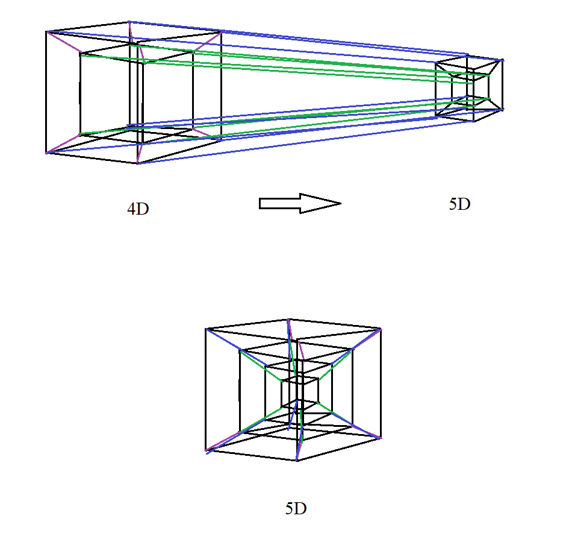
When 4D mind and thought are brought into the view of fifth dimensional consciousness, 4D expands into 5D. 5D consciousness views both third dimensional information and interaction, as well as mind and thought.
3D information and interaction: Things
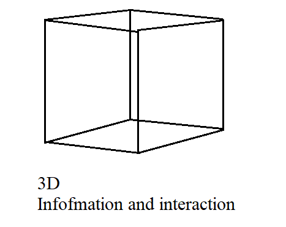
Our three-dimensional reality is made up of events and things. Things can be various manifestations, such as people and animals, or objects and physical forms. These things make up a whole that we call reality.
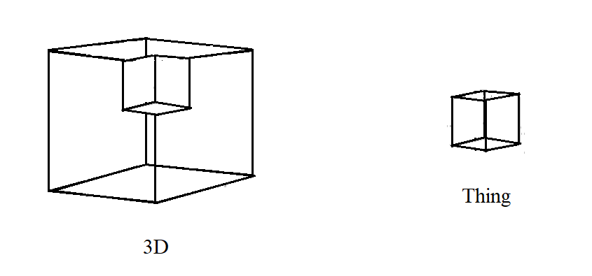
Things also have different properties, which in this case are called factors. Different factors can be, for example, properties or variables.
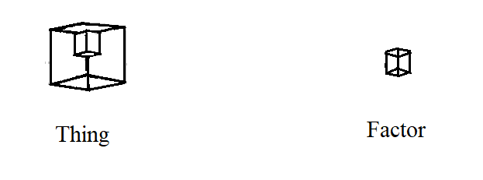
Our reality could appear very chaotic without rules, but our reality is based on rules and facts that are unchanging. That is why our reality also appears consistent. Things follow rules, such as the various laws of Physics or Biological mechanisms and processes.
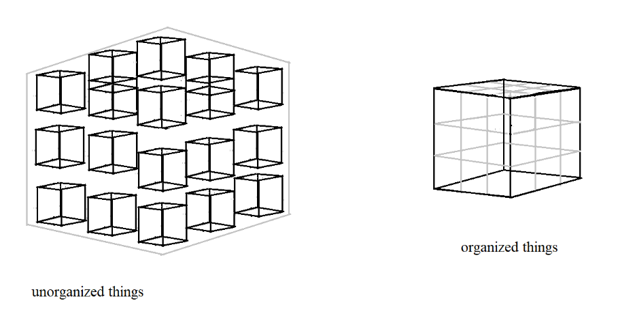
Our three-dimensional reality therefore consists of a systematic structure, in which the whole is made up of things and the factors that influence them.
4D, Mind and thought; thought structures
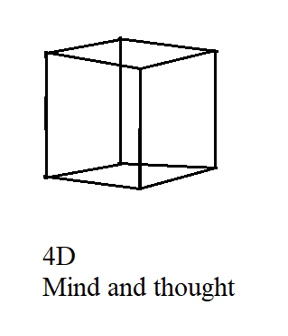
We interpret our three-dimensional reality through the mind’s thought, the fourth dimension. Information from the third dimension flows in and out along the coordinate for processing by the mind and thought.
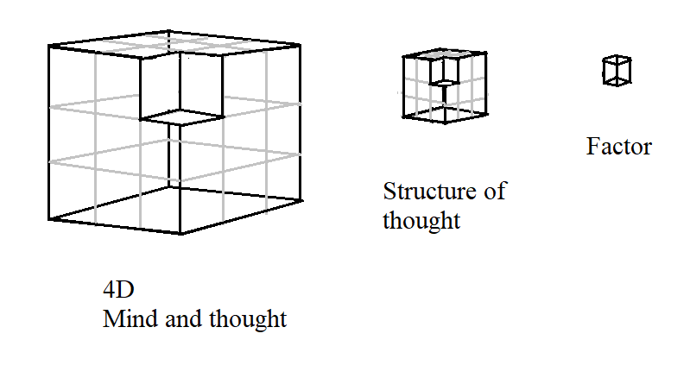
Mind and thought are the mental equivalent of the third-dimensional reality. Whereas in the third dimension there are things and factors, in the fourth dimension things correspond to thought structures, and thought structures are formed by factors that influence thought structures, such as attitude or consistency.
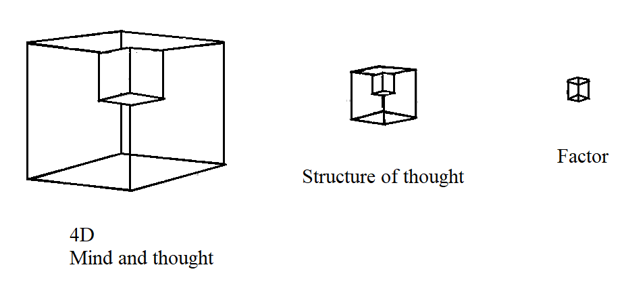
Thought, however, is not based on the same regularity as things in the third dimension. However, the mind can be organized and coherent.
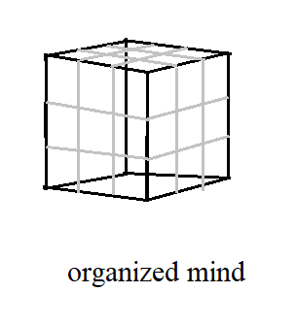
The mind is therefore made up of different thought structures, and thought structures are made up of different factors.
three-dimensional reality thus expands into a fourth dimension with mind and thought. These identical cubes, although representing different properties, together form a tesseract.
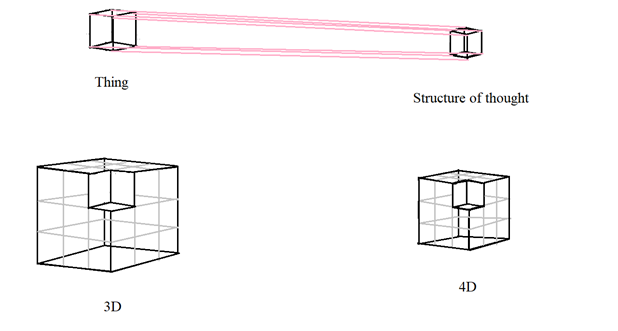
The counterpart of things in the third dimension is therefore a thought structure in the fourth dimension. For every thing that manifests in reality, there is a thought structure. These thought structures are created through childhood. They have the opportunity to be developed and shaped, and to be formed into something more coherent, truthful, and clear.
When we think of contradictions, they usually arise from the fact that thought structures do not correspond to the true nature of things.
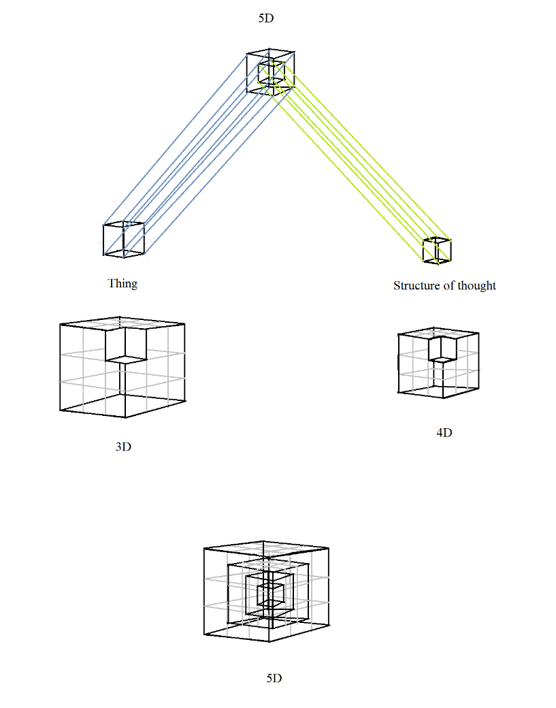
The role of consciousness is to examine both the mind and thought, as well as the three-dimensional reality. Consciousness experiences these third-dimensional events and things, and examines the thought and interpretation of the third-dimensional reality created by the fourth-dimensional mind and thought. This therefore creates a role that examines whether the third-dimensional information and the thought structures created from it correspond to each other.
This model updates the diagrams presented in the Inside the Cube thesis and Hypercubism , Part II – documents. More detailed justifications can also be found in those documents.
Method
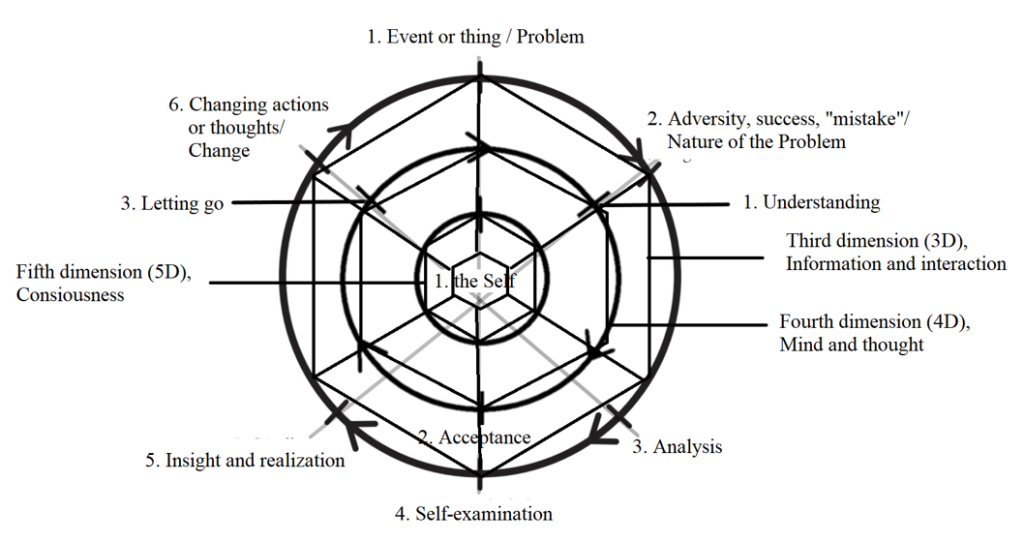
Metatronism includes the Life is Circular philosophy of life and the Theory of Dimensions (3D, 4D, 5D) combining tool, Metatronics .
Whereas self-examination works by examining events, things, and problems that actually occur , dimensions provide a framework for the factors observed during self-examination.
The Philosophy of life being circular consists of three parts:
- Six-stage self-examination
- The three stages of being
- The self
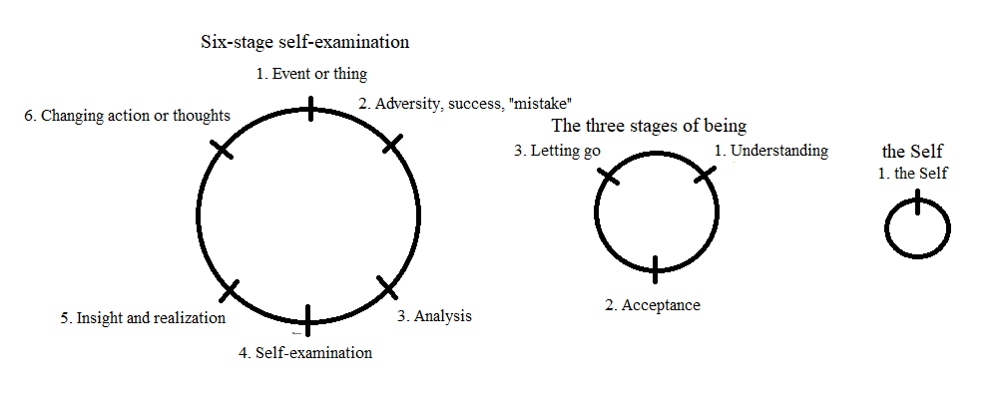
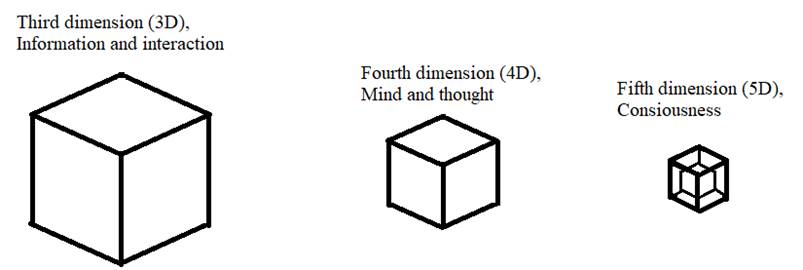
The theory of dimensions consists of three dimensions that interact with each other:
- The third dimension (3D), Information and interaction
- Fourth dimension (4D), Mind and thought
- Fifth dimension (5D), Consciousness
Third dimension (3D), Information and interaction <- Six-stage self-examination
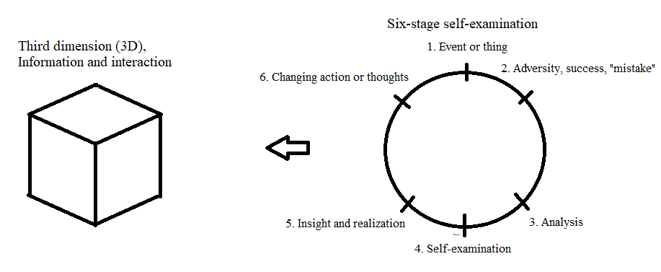
The third dimension of information and interaction also includes events, issues, and problems. Although problems can sometimes be related to thought structures or ways of thinking, they ultimately originate from information in the third dimension. An event, issue, or problem is therefore the starting point for examining the event, issue, or problem.
The fourth dimension (4D), Mind and thought <- The three stages of being
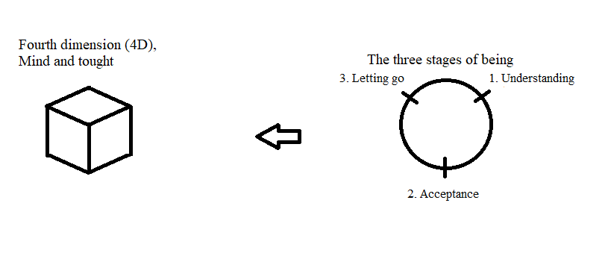
The fourth dimension of mind and thought includes thinking, interpretation, and thought structures. Understanding, acceptance, and letting go of the three stages of being are tools that work in the mind and thought. Understanding also acts as a bridge between the fourth and fifth dimensions.
The fifth dimension (5D), Consciousness <- the Self
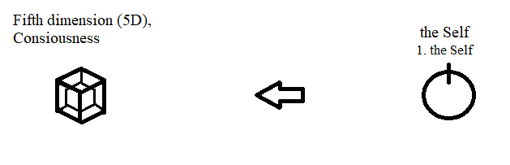
The fifth dimension of consciousness includes observation, examination and questioning of thoughts, but also the perspective brought by intelligence. The self functions in consciousness and is equal to consciousness
Integration
In Metatronics , consciousness is the basis of everything, from which thinking derives its observer. The mind and consciousness, in turn, need the information and interaction of the third dimension to construct thought structures.
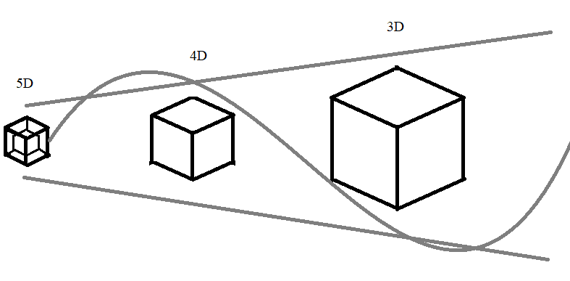
Self-examination begins with examining the events and things contained in third-dimensional information and interaction, moving on to examining the ways of the mind and thinking as well as thought structures, always ending up with one’s own self, the self.
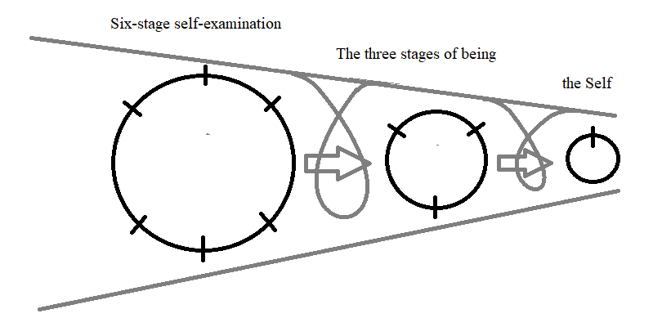
The learning process thus begins with awareness of one’s own thinking and physicality. After this , integration is a wave-like learning process .
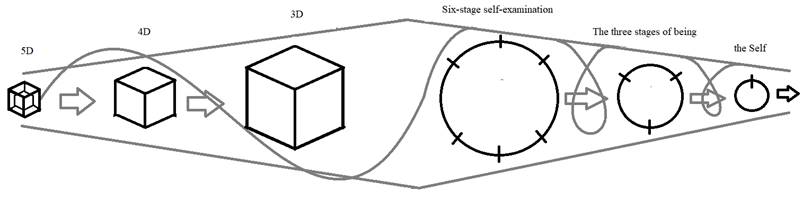
When self-awareness is achieved through self-examination, consciousness itself becomes a visible factor. The self stage and the fifth dimension of consciousness (5D) merge into one.
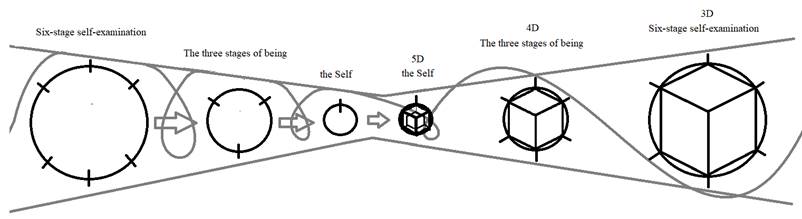
Life is in the shape of a Circle philosophy and the Theory of Dimensions merge into a single, unified whole called Metatronics .
Principles
Axioms
Axiom 1: Structural reality
Reality is structural. Everything that exists manifests itself as organized information and interaction.
Axiom 2: Third dimension (3D)
3D is the physical dimension of information and interaction, which includes matter, energy, biological life, cause-and-effect relationships, and the laws of nature.
3D is the dimension in which we live, and it is the foundation for other dimensions.
Axiom 3: The fourth dimension (4D)
4D is the dimension of mind and thought.
It arises when the physical structure develops sufficiently. 4D enables thought, imagination, and interpretation.
4D cannot exist without 3D.
Axiom 4: The fifth dimension (5D)
5D is the dimension of consciousness.
It is not a physical dimension, but a dimension that enables experience, awareness of one’s own existence, and examination of the mind.
5D is the depth dimension of experience.
Axiom 5: The Foundation
5D is the fundamental dimension.
It does not originate from 3D, but becomes visible through 3D. Without 5D, reality would be mere structure; 5D is the dimension through which reality becomes experienced .
Principles
Principle 1: Integration
3D and 4D together form a structure through which 5D can manifest.
Without 3D, 5D cannot function in this reality.
Without 5D, 3D–4D structure lacks lived experience.
Principle 2: Embodiment
Consciousness attaches itself to the individual body.
This:
– prevents consciousnesses from mixing
– enables individual experience
– limits consciousness to the conditions of the physical world
Principle 3: Continuous structure
The dimensions form a hierarchy:
3D → 4D → 5D
– 3D provides structure
– 4D provides interpretation
– 5D provides experiential intelligence
A higher dimension includes the lower one, but is not the same as the lower one.
Summary
Axioms define the three dimensions of reality: information and interaction, mind and thought, and consciousness
Principles describe how these levels work together and why individual experience is possible.
Vision
Metatronism changes the way we see the structure of reality and experience. Geometric architecture enables precise mathematical analysis of the contradictions experienced by humans in life, and the model also makes it possible to point out errors and misjudgments.
The geometric architecture and philosophy of Metatronism can be utilized in the knowledge-based development of artificial intelligence, in the interpretation and study of human behavior, as a therapy tool, and as a modeler of cognitive processes.
of Metatronism has already been applied to art, Hypercubism, and it has unlimited possibilities for use in VR art, or in the analysis of art in general.